Catch up on a variety of FDA news in radiology from the past week.
Pelvic CT with filtered back projection and 50% ASIR reduces dose.
Patients may be exposed to significantly less radiation when undergoing pelvic computed tomography (CT) if the imaging study is done with a filtered back projection and 50% adaptive statistical iterative reconstruction blending ratio reconstruction (ASIR50), according to the results of a study published recently in
Specifically, use of this technique on 45 patients by researchers from Qianfoshan Hospital, China, resulted in greater than 50% reductions in CT dose index volume, dose-length product, and effective dose compared with a routine-dose CT with filtered back projection.
“The current study revealed that when compared to low-dose CT images with filtered back projection, low-dose CT images with ASIR50 more clearly displayed lesion edges and contours, and further improved diagnostic acceptability,” the researchers wrote. “In addition, low-dose CT images with ASIR50 allowed the visualization of various pelvic organs that was comparable to routine-dose CT images with filtered back projection, and fully met the requirements for disease diagnosis and treatment.”
Currently, there are limitations in how much radiation dose can be reduced without affecting image quality. These limitations are caused in part because of the standard filtered back projection reconstruction used in CT systems. In contrast, early studies of adaptive statistical iterative reconstruction has shown an association with better image quality and reduced image noise.
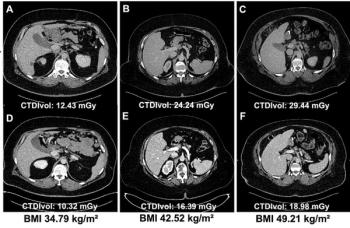
This study evaluated 45 patients who underwent a routine CT with filtered back projection, or a low-dose CT with filtered back projection and ASIR50. Patients who underwent the low-dose procedure had a mean CT dose index volume of 10.80 mGy, a mean dose limiting product of 265 mGy/cm, and a mean effective dose of 3.97 mSv. When compared with the standard-dose CT protocol, these rates resulted in decreases of 62%, 55%, and 56%, respectively, for the three measures.
Image quality scores were significantly lower when looking at low-dose CT with filtered back projection compared with the same procedure with ASIR50 or standard-dose CT with filtered back projection. In addition, the reviewers ranked image quality of low-dose CT with ASIR50 as significantly better than low-dose CT with filtered back projection. Overall, the results showed no subjective or objective differences in image quality between the three procedure types.
The researchers noted that this study was small and retrospective in nature. Further study is needed to confirm the utility of low-dose CT with filtered back projection and ASIR50.