






Doctors from China, Japan, India, and Australia have strengthened DI Asia Pacific's Editorial Advisory Board.

Doctors from China, Japan, India, and Australia have strengthened DI Asia Pacific's Editorial Advisory Board.
The American College of Radiology Imaging Network will expand its research scope beyond cancer to add applications that advance clinical care in areas such as neuro and cardiovascular imaging.
More than eight years of data from nearly 500 patients suggest that frequent monitoring with CT to look for complications after endovascular repair of abdominal aortic aneurysms is unnecessary and that it could be done instead with ultrasound.
Multislice CT angiography can save lives byidentifying occult congenital cardiac anomaliesand disease that could lead to suddencardiac death among competitive athletes.
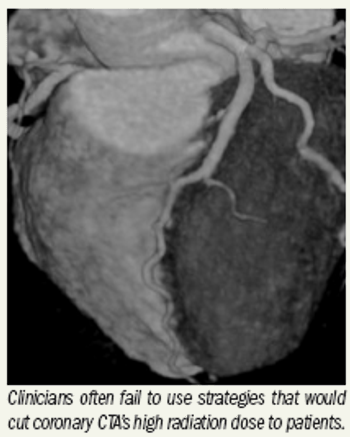
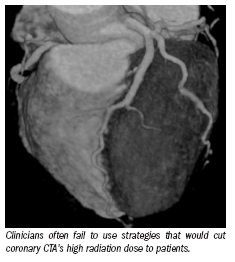
Cardiac imagers are accentuating positive aspects of an international multicenter study of cardiac multislice CT imaging, despite a wide variation in the amount of radiation exposure among 1965 patients and the generally infrequent use of available dose reduction strategies.
High calcium scores are commonly considered a risk factor for coronary stenosis, but even a zero calcium score doesn’t assure coronary health in a high-risk population, a pair of papers presented Monday concluded.
MR systems used in cardiovascular imaging will inevitably have higher field strengths, including 7T, according to a leading cardiac radiologist.
Cardiac researchers assessing the benefits of revascularization therapies will operate a little less in the dark thanks to salvage imaging, a new cardiac MR technique that relies on T2-weighted pulse sequences
Just as arterial calcium predicts coronary artery disease, the presence and extent of fat accumulations around the heart may indicate the presence of atherosclerosis.
Cardiac MR can demonstrate the effects of airway pressure therapy in the hearts of patients with obstructive sleep apnea. In the first study of its kind, researchers at Ohio State University Medical Center found that it could document therapeutic benefits on structure and function to the heart’s right side.
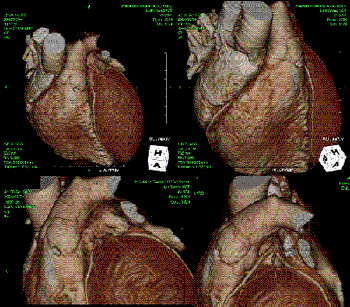
Multislice CT angiography can save lives by identifying occult congenital cardiac anomalies and disease that could lead to sudden cardiac death among competitive athletes.
An international clinical trial involving 50 healthcare facilities and nearly 2000 patients has found that physicians often do not apply available dose reduction strategies in procedures, resulting in a wide variation in radiation exposure.
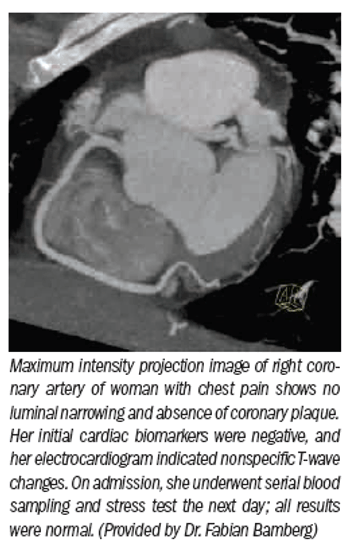
Cardiac imaging researchers are validatingbroader clinical roles for 64-slice and dual-source CT while introducingthe radiological world to evenmore powerful machines that promiseto lower radiation exposure andimprove resolution.
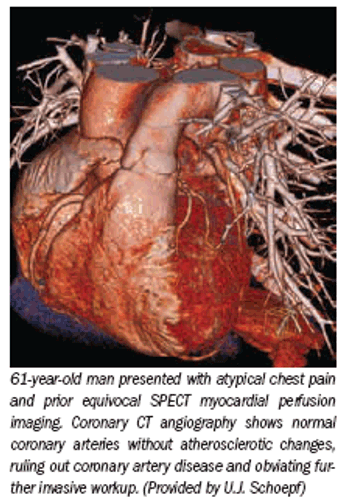
Radiologists were urged at the RSNA meeting to combat distortedreports about cardiac CT radiation exposure that raiseunreasonable public anxiety about the risk of medical imaging.
Most radiologists know about the medical risks associated with patient exposure to ionizing radiation, but many are still in the dark about basic steps they can take to reduce patient exposure. A University of Michigan survey presented at the RSNA meeting found that a surprising percentage were unaware of methods to adjust mA and kVp during CT procedures.
More stringent criteria to evaluate emergency room patients under 40 years of age with suspected pulmonary embolism could decrease radiation exposure while also saving time and money, according to research presented at the RSNA meeting.
The imminent publication of eagerly anticipated new international guidelines promises to transform the complex area of lung cancer staging.
There is nothing like a little momentum to help the RSNA organizers present the latest developments in imaging research in the meeting’s scientific sessions. Everyone associated with imaging sciences from Beijing to New York City understands that presenting research in Chicago is an essential requirement for membership in this unique community.
The attention of the medical imaging community looks set to turn to Seoul later in October, when the 12th Asian Oceanian Congress of Radiology will be held. This is the first time the congress has been staged in Korea since its debut event in 1971, and, given the high quality of radiological practice within the country and its strong educational links with the U.S., the conference is bound to attract plenty of interest. The number and expertise of the invited speakers from North America are certainly impressive.
Coronary artery anomalies are rare, occurring in 0.3% to 1% of the general population. But the clinical importance of these anomalies is significant. Coronary artery anomalies have been found to be a major contributing factor in sudden cardiac deaths in young adults.
Oxford University researchers have established that aortic regurgitation fraction, measured with cardiac MR, accurately singles out patients who need aortic valve replacement.
With piles of accumulated evidence demonstrating the ability of multislice CT to diagnose coronary artery disease, researchers are expanding clinical application of the modality to the measurement of myocardial viability following infarction.
Interest in cardiac imaging with multislice CT is growing, as evidenced by the large number of studies that have been published on this topic. Advances in cardiac MSCT have also been aided by the introduction of extremely fast, user-friendly scanners.
Coronary heart disease is one of the leading causes of morbidity and mortality in developed countries.1 Accurate detection of early cardiac disease is of utmost importance for the delivery of appropriate treatment.