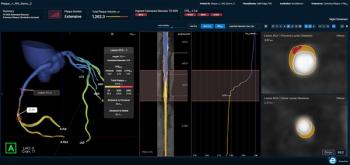
The FFR-IQ software recently demonstrated a 92.2 percent sensitivity for non-invasive estimation of fractional flow reserve (FFRC) based on coronary CT angiography (CCTA) scans.
Using CT colonography for screening of colorectal cancer among Medicare patients is cost-effective.
Computed tomography colonography (CTC) is a cost-effective screening option for colorectal cancer (CRC) among the Medicare population, and will likely reduce Medicare expenditures for CRC screening, according to a study published in
Researchers from Milliman, Inc. in New York City, and University of Wisconsin School for Medicine and Public Health in Madison, compared the cost of CRC screening by CTC of average risk individuals in the Medicare population with the cost of screening by optical colonoscopy (OC).
The researchers obtained Medicare claims data, fee schedules, established protocols, and other sources in order to estimate the costs of CTC and OC, which were then compared with CTC and OC screening recommendations.
A total of 127,175 Medicare colonoscopies were performed in 2013, 56,578 (44%) were classified by the researchers as screening, for purposes of calculating average costs. The remaining were excluded because they were coded as diagnostic (46%), were performed on the same day as an upper endoscopy (7%), were incomplete (2%), or because the Medicare enrollee was younger than 50 (1%).
Costs varied depending on the codes used, but on average, the screening costs for Medicare colonoscopy was $1,035. Accompanying biopsies raised the costs to an average of $1,212. Without biopsy, the average cost was $824. “Most of the cost difference was due to the professional and technical fees for the colonoscopy and not pathology costs,” the authors wrote. “Pathology costs averaged $92 for a colonoscopy with biopsy.” More than half (54%) of colonoscopies had a biopsy.
Cost variations depended on:[[{"type":"media","view_mode":"media_crop","fid":"42788","attributes":{"alt":"colorectal cancer screening","class":"media-image media-image-right","id":"media_crop_780162765934","media_crop_h":"0","media_crop_image_style":"-1","media_crop_instance":"4653","media_crop_rotate":"0","media_crop_scale_h":"0","media_crop_scale_w":"0","media_crop_w":"0","media_crop_x":"0","media_crop_y":"0","style":"height: 135px; width: 180px; border-width: 0px; border-style: solid; margin: 1px; float: right;","title":"©Spectral-Design/Shutterstock.com","typeof":"foaf:Image"}}]]
• Whether the colonoscopy involved separately billed anesthesia
• Site of the colonoscopy (outpatient hospital, ambulatory surgical center, or physician office)
• Number of biopsies
• Bowel preparation agent
• Provider locality
The findings showed that CTC was 29% less expensive than was OC for the Medicare population in the base scenario, and was a cost-effective screening option.
“The findings confirm that CT colonography hits upon the ‘triple aim’ that Medicare policies strive to achieve-it improves the patient experience as no anesthesia is required, allowing for immediate resumption of daily activities; as an effective screening tool for colon cancer, it improves population health; and it reduces the cost per capita of health care,” Patrick Hope, executive director of the Medical Imaging & Technology Alliance (MITA), said in a release. “We hope this data will encourage the Centers for Medicare & Medicaid Services to cover this service as it will grant more American seniors access to a cost-effective tool to detect colon cancer early, when it is more treatable.”
The