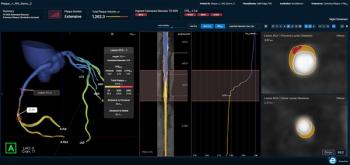
The FFR-IQ software recently demonstrated a 92.2 percent sensitivity for non-invasive estimation of fractional flow reserve (FFRC) based on coronary CT angiography (CCTA) scans.
CT colonography screening compliance could be increased by 15 percent if covered by Medicare or third-party payers.
CT colonography screening compliance could be increased by 15 percent if covered by Medicare or third-party payers, said researchers in a study published in the July issue of
In 2009, the Centers for Medicare and Medicaid Services indicated that routine CT colonography would not be covered due to a lack of information that supported the effectiveness of the examinations.
To address this issue, researchers at the National Medical Center in Bethesda, Md, evaluated the outcomes of over 14,000 patients aged 65 years or older who underwent screening colonography between 2004 and 2009. It was found that the referral rate to colonoscopy among this patient group was 14 percent, similar to that of younger patients.
“The prevalence of neoplasia (abnormal growths of cells) detected by CT colonography was 9.3 percent in patients over the age of 65,” said Brooks Cash, MD, one of the study authors. He pointed out that potentially important extracolonic findings were identified in 2.9 percent of the study group. “The confirmation of low rates of referral to colonoscopy, the prevalence of advanced neoplasia and the prevalence of extracolonic findings makes CT colonography a valuable option for Medicare-aged patients.”
Addressing the issue of radiation dose during colonoscopy, another concern of the Centers for Medicare and Medicaid Services, Dr. Cash said, “The average effective radiation dose with CT colonography at the national Naval Medical Center was calculated to be 4.24 mSv per CT colonography examination. To put that into perspective, the average yearly radiation exposure of American adults is about 6.2 mSv.”