Register Now: Image-Based Risk: The Next Frontier in Breast Cancer Screening
|Articles|January 21, 2021

FDA Clears Canon Medical's AI-Powered Large-Bore CT

Aquilion system offers industry’s largest bore and widest field-of-view, potentially augmenting radiation therapy planning.

Canon Medical Systems received clearance from the U.S. Food & Drug Administration (FDA) Thursday for its Aquilion™ Exceed LB CT system that is designed to improve the planning and delivery of radiation therapy.

As an artificial intelligence-powered system, company officials said, Aquilion is intended to facilitate workflow while maintaining image quality and reproducibility.

“The Aquilion Exceed LB was designed to push the boundaries of traditional simulation,” said Erin Angel, CT business unit managing director for Canon Medical. “Deep learning reconstruction will give radiation oncology teams the confidence they need for accurate and precise planning across patients.”

Based on company details, Aquilion offers several benefits:
  • 90-cm bore (industry’s largest bore opening)
  • 90-cm extended-to-edge field-of-view reconstruction
  • 4-cm wide detector coverage
  • AI-powered contouring, using Canon Medical’s Advanced Intelligent Clear-IQ Engine (AiCE) deep learning reconstruction (DLR) technology
  • Flexibility for handling bariatric patients, challenging patient positioning

Related to this article

Key Sessions of Interest for Radiologists at the Upcoming HLTH USA Conference
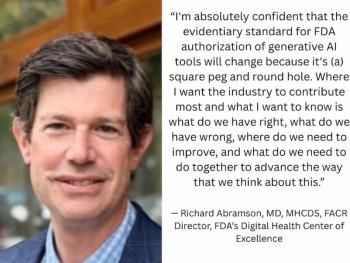
How will generative AI software be evaluated by the FDA in the future? What’s next for point-of-care ultrasound? What steps have been successful in facilitating adoption of AI applications across enterprise systems? Leaders in radiology and health care will be discussing these topics and more at the upcoming HLTH USA conference.
Current Perspectives on Integrating AI into Radiology
In a recent interview with Diagnostic Imaging, Joseph Cavallo, MD, MBA, offered insights on post-deployment monitoring with AI, the potential for improved workflow efficiency and the ongoing challenge of balancing essential clinical skills and AI literacy in the training of radiology residents and fellows.