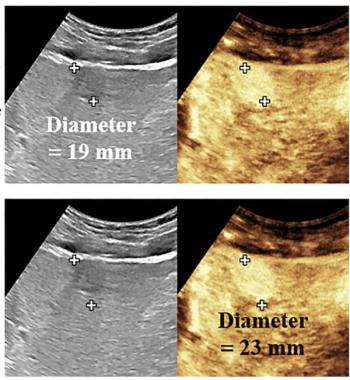
For patients with hepatocellular carcinoma (HCC), perfusion beyond tumor margin on contrast-enhanced ultrasound that exceeds gray-scale ultrasound tumor measurement by 5 mm is associated with a 76 percent higher risk of worse recurrence-free survival, according to newly published research.
In the second of a three-part podcast episode, Wendie Berg, MD, PhD, FACR, FSBI, Manisha Bahl, MD, and Amy Patel, MD discuss how to handle disagreements with adjunctive AI in breast imaging, whether to include AI assessments in PACS, and whether patients should pay for the use of adjunctive AI.
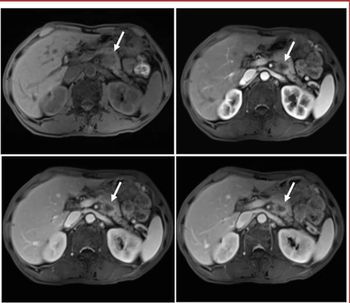
Magnetic resonance imaging offered a 29 percent higher sensitivity than CT for differentiating liver metastases, but CT provided 12 percent higher sensitivity than MRI for assessing vascular invasion, according to a new 40-study meta-analysis.
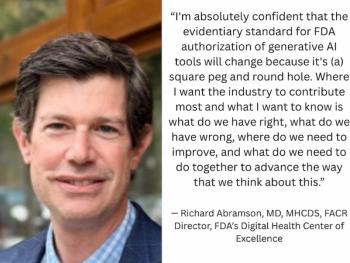
How will generative AI software be evaluated by the FDA in the future? What’s next for point-of-care ultrasound? What steps have been successful in facilitating adoption of AI applications across enterprise systems? Leaders in radiology and health care will be discussing these topics and more at the upcoming HLTH USA conference.
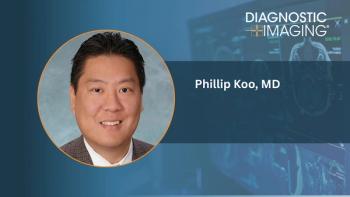
In a recent interview, Phillip Koo, MD, discussed emerging trends with AI, theranostics and empowered patients, and how these developments may lead to challenges and potential opportunities for radiologists and nuclear medicine physicians.