

While AI offers the lure of efficiency and cleaner writing in scientific research, maintaining the principles of authorship and intellectual engagement is perhaps more important than ever before.
While AI offers the lure of efficiency and cleaner writing in scientific research, maintaining the principles of authorship and intellectual engagement is perhaps more important than ever before.
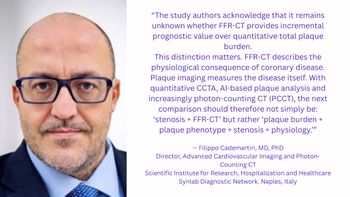
Does fractional flow reserve (FFR) or quantitative plaque burden from CCTA provide greater prognostic insight into coronary disease?
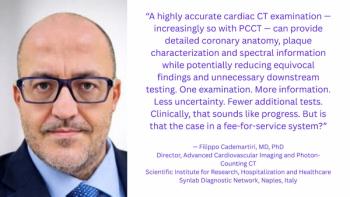
While better imaging may reduce the need for additional diagnostic tests, it may also eliminate the reimbursement that comes with those additional tests.
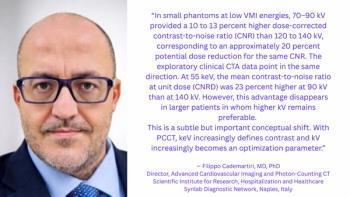
Emerging research demonstrates the increasing stability of attenuation on clinically relevant VMIs with photon-counting CT and a redefined role of kV that may have implications for longitudinal quantitative CT.
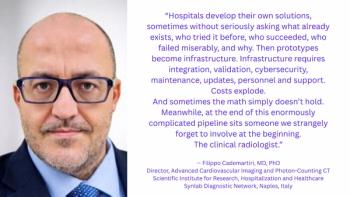
While AI tools abound in radiology, how many AI-enabled software products have incorporated insights from clinical radiologists?
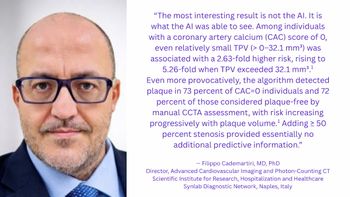
A new study shows that even small plaque volume may be associated with significantly higher risk for cardiovascular events, making the enhanced spatial resolution available with advanced imaging even more critical in risk stratification.
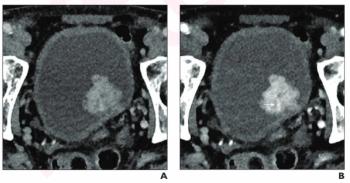
Reducing false positives in evaluation of muscle invasion in bladder cancer cases that can occur with conventional imaging, spectral information with photon-counting CT may offer significantly improved accuracy and specificity in local staging.
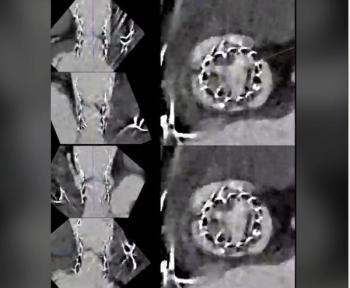
The high-resolution temporal and spatial imaging with photon-counting CT bolster our understanding of the connections between anatomy and function in structural heart imaging.

Catch up on the latest blogs from Filippo Cademartiri, MD, PhD, who discusses topics ranging from CCTA scan acquisition and photon-counting CT to artificial intelligence and assessment of current plaque as a biomarker for evaluating MACE risk.
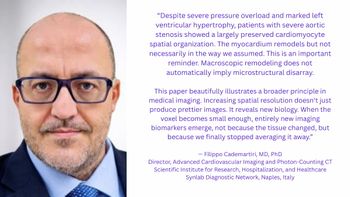
Smaller voxel size may offer insights into biology we could never access with conventional resolution.
Advanced imaging with photon-counting CT and AI detection of subtle calcification may lead to a reevaluation of the power of zero with coronary artery calcium (CAC) scoring.
In the age of advanced CCTA imaging, a one-size-fits-all approach to image acquisition is a disservice to patients.
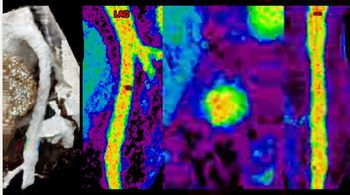
Photon-counting computed tomography (PCCT) is a foundational cornerstone that can facilitate detection, targeting and reversal of coronary artery disease.
Emerging research demonstrates that those with total plaque volume > 750 mm3 have an 18.6 percent risk of MACE at four years in comparison to a 1.4 percent MACE risk for those with no plaque.
New research suggests that photon-counting CT may provide critical insight into a diagnostic dilemma that has challenged radiologists for decades.

New research suggests the silent accumulated social costs of remote work are outweighing the benefits of increased flexibility and autonomy.
Emerging CCTA research affirms the importance of going beyond LDL reduction in the evaluation and treatment of patients with chronic coronary syndrome.
The role of the radiologist is shifting, not into obsolescence but more of an architect of AI implementation and workflow orchestration in a continuously evolving health-care system.
The benefits of photon-counting CT via ultra-high spatial resolution, reduced blooming artifacts and high temporal resolution allow characterization with confidence in coronary stent assessment.
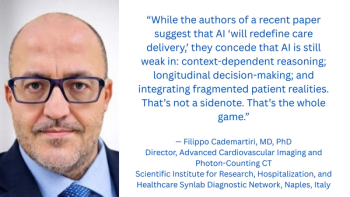
Are we overestimating the capacity of AI to address the ambiguity inherent to real-world medicine?
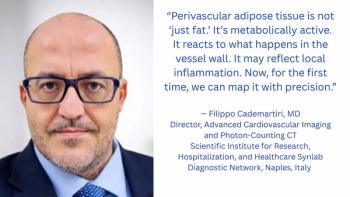
New research demonstrates the capability of photon-counting CT to go beyond stenosis and inflammation to offer precision mapping insights into the individualized metabolic activity of carotid perivascular adipose tissue.

Research focused on the causes, diagnosis, treatment, and prevention of cardiovascular disease is progressing rapidly.1 Radiology has always played a central diagnostic role, particularly in the coronary vessels. A technique for selectively catheterizing the coronary arteries was developed in 1959, and conventional x-ray coronary angiography is still considered the gold standard for detecting coronary artery disease.2
August 18th 2005