

Blog|Articles|December 29, 2025
Out of the Mouths of Babes: Radiologist Potential is Everywhere
Author(s)Eric Postal, MD
What behaviors and aptitudes for learning may be conducive to a future career in radiology?
Advertisement
Polite society has developed a funny balancing act when it comes to pride and humility. You can openly pat yourself on the back for some things, but for other stuff it’s gauche. Try a “humblebrag” and you might get called out for it. Letting others sing your praises is safest but if you have a big appetite for that, you might starve.
That is just as well. What seems boast worthy to any particular individual is often insanely boring to those surrounding him or her. If you don’t believe me, try telling some random bystander about all the hard work it took for you to become a radiologist and what you have to do to maintain your professional viability. Watch how fast their eyes glaze over.
There is another reason to keep one’s feet firmly planted on humble ground. Most of us just aren’t that special. I am of a mind that, with sufficient advance preparation and a decent game plan, an awful lot of folks could be guided into our field who, on their own, might not find their way there. Three nephews and a niece visiting me for the holidays each proved this to me in their own way.
Of course, their differing levels of maturation and individual styles were on display in the process with an age range between 10 to 15. The next-to-eldest’s rad potential was most blatant: He came up with a series of radiology quiz questions on his tablet and kept approaching me with his thoughts and favored answers.
Add almost 20 years to his age, and he could have been any senior year radiology resident, prepping for board exams. Your mileage may vary, but I am hard pressed to remember spending more time on any other aspect of my exam prep. It was all about finding “question banks” and going over as many test-related items as we possibly could.
You didn’t need to have any repeated verbatim on exam day (although that would be a sweet bonus). Mere similarity between study materials and the actual test would be a healthy leg up. Getting into the test taking mental rhythm was helpful of course. Building confidence from having repeatedly gone through countless prep questions also had value.
Yes, there was learning too. Getting a prep question wrong activated your “uh-oh” sense and motivated you to more firmly secure that tidbit of info in your noggin, even occasionally acquiring some new factoid that you somehow failed to glean during previous years of training.
The youngest nephew showcased potential for an earlier phase of radiological education. He didn’t always understand what the older folks around him were talking about, but that didn’t slow him down much. He parroted them eagerly, sometimes trying to present their statements as his own. (I might or might not have quietly introduced his sister to the term “plagiarist” as a retort.)
Add almost 20 years to his age, and he would be well equipped for newbie training in radiology residency, or at least med school. At that point, your whole purpose in life is to absorb as much information as you can and be ready to regurgitate when necessary.
That starts with basic facts but progresses to sophistication in how to use them. A thoroughly green trainee might blurt out everything he or she can think of but with some seasoning, he or she will develop some timing and style: When you get to the end zone, act like you have been there before. Let the folks junior to you spit out the easy answers and let your quieter reserve imply you already know them (which you hopefully do by then).
The final form of that was known to those of us who made trips to Louisville for oral boards. Anything you say can and will be used against you. Answer questions as minimally as possible, lest you offer some extra tidbit that gets you in trouble by giving your examiners something to focus on as a follow-up question. (This is also good practice if you ever have the misfortune of being deposed.) To borrow a phrase, less is more. Use silence well.
Along with medical/radiological facts, one learns to adopt, if not parrot, the shared experiences of mentors. I didn’t personally come up with the observation that ERs were using CT as a triage tool, for instance, but after hearing my attendings comment on the trend a few times, I had permanently added it to my mental repertoire. Left to my own devices, I might have taken years to reach the same conclusion and even more to phrase it with that clever twist.
The eldest nephew was further along in his thinking at the post-residency level. He was curious about my actual work structure or rather the absence thereof. How was it that I didn’t, strictly speaking, have a job, complete with boss and all the usual trappings of employment?
I told him what many rads learn for themselves, sometimes painfully, after completing training and starting to chart their own course: the traditional “get a job, work hard, become partner or department chair” path isn’t what it once was, and it is not a personal deficiency for those who discover it is not for them.
Especially for rads, the telemedicine sphere (and a strong job market) can enable a series of lateral moves, progressively developing a career that suits you well even if it wouldn’t satisfy many others. For instance, I am willing to earn substantially less in exchange for not working nights and weekends. Even so, the series of job switches I have detailed in previous editions of this blog have steadily improved every aspect of my professional life, including income.
My niece, next to youngest, was probably the most advanced proto radiologist of all. She quietly sat with her noise-canceling headphones on, doing her own thing without distraction from the rest of us except for when she chose to remove them and interact. Throw 30-plus years at her, and her hourly RVU rate would probably put the rest of us to shame.
Advertisement
Related to this article
While the allure of partnership or a hierarchical promotion system for those who paid their dues once sounded promising, the current reality amid declining reimbursements, thinning practice margins and private equity acquisitions is going after the gig with the most optimal lifestyle and paycheck.
While AI offers the lure of efficiency and cleaner writing in scientific research, maintaining the principles of authorship and intellectual engagement is perhaps more important than ever before.

Has the barrage of passwords, PINs and authenticator apps gone around the bend to a point where it hampers efficiency and productivity?
Does fractional flow reserve (FFR) or quantitative plaque burden from CCTA provide greater prognostic insight into coronary disease?
Constant grumbling from an attending radiologist about the road ahead may be a sign that his or her best teaching years may be in the rear-view mirror.
While better imaging may reduce the need for additional diagnostic tests, it may also eliminate the reimbursement that comes with those additional tests.
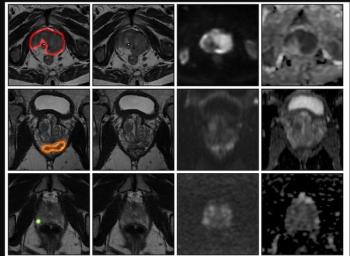
An AI model for prostate MRI offered an 89 percent AUC for prostate cancer detection in external validation testing, according to a newly published international multicenter study.
In the latest episode of her Breast Imaging in Focus series, Manisha Bahl, MD, MPH, FSBI, discusses new research comparing mammography-based AI models for breast cancer detection and short-term risk prediction.
Advertisement
Advertisement
Trending on Diagnostic Imaging
1
Breast Imaging in Focus: Can AI Models for Breast Cancer Detection and Risk Prediction Be Used Interchangeably?
2
Molecular Imaging in Focus: Comparative PSMA PET Study Offers Insights for Men with Recurrent PCa and Low PSA Values
3
Can CT Bone Reading Software Enhance Detection of Metastatic Rib Lesions in Women with Breast Cancer?
4
Teleradiology With More Pay and Less Pressure
5