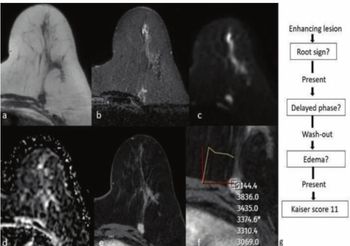
A Kaiser score > 5 with breast MRI demonstrated a 97 percent sensitivity and 87.9 percent specificity for predicting malignancy in patients with BI-RADS 0 or 4 presentations on mammography and breast ultrasound, according to a new study.
In a recent interview with Diagnostic Imaging, Wendie Berg, MD, PhD, shared her perspective on various aspects of the controversial breast cancer screening guidance issued by the American College of Physicians (ACP), including the use of supplemental imaging in women with dense breasts.
One of the more controversial components of the
Wendie Berg, MD, PhD, in a recent interview with Diagnostic Imaging, noted that DBT is far from “supplemental” at this point in mammography screening in the United States.
“It’s really pretty much the routine at almost all centers. … Most centers do the tomosynthesis with synthetic reconstruction so you really don't need a separate 2D mammogram. It is done as your annual mammogram with tomosynthesis or 3D reconstructions. That's certainly something that is kind of a no-brainer (in) that all women should be expecting, especially (those) with dense breasts. (to get) tomosynthesis as their routine screening exam,” noted Dr. Berg, a distinguished professor and Dr. Bernard F. Fisher Chair for Breast Cancer Clinical Science at the University of Pittsburgh School of Medicine.
Dr. Berg also challenged the ACP’s recommendation against supplemental MRI or breast ultrasound for women with dense breasts.
“ … They summarize the evidence (on supplemental screening) to some degree in this article that they published with these guidelines, but they do ignore a lot of other evidence. We certainly know with even with ultrasound, but especially with MRI, that we have reduced symptomatic interval cancers. We have better outcomes. We have reduced late-stage disease,” maintained Dr. Berg, chief scientific advisor for densebreast-info.org.
Dr. Berg also pointed out that the ACP guidance on supplemental imaging contradicts updates to the Employee Retirement Income Security Act (ERISA) guidelines that went into effect in January 2026. While noting exceptions with Medicare and TRICARE insurance, Dr. Berg said the ERISA guideline updates require insurance to cover supplemental testing to ensure adequate completion of breast cancer screening and recognize that this need may be more common in women with dense breasts.
“This is something that women can expect insurance to cover and actually cover in full with no co-pay or deductible, including diagnostic testing and even biopsy that results from that screening,” emphasized Dr. Berg.
(Editor’s note: For related content, see “