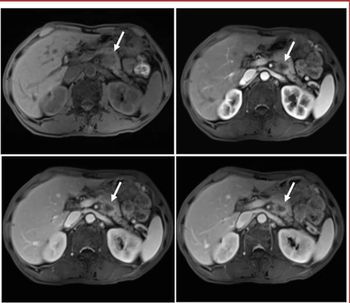
Three Key Takeaways
1. Higher sensitivity for small lesions. Gd-EOB-DTPA-enhanced MRI showed a significantly higher sensitivity (94 percent) for detecting NETLM lesions smaller than 10 mm compared to dual-layer spectral detector CT (80 percent) and polyenergetic CT (66 percent).
2. Superior diagnostic accuracy. Gd-EOB-DTPA-enhanced MRI achieved a 95 percent sensitivity rate and a 97 percent area under the curve (AUC) for diagnosing NETLM, outperforming DLCT (86 percent sensitivity, 91 percent AUC) and polyenergetic CT (76 percent sensitivity, 86 percent AUC).
3. Limitations of Gd-EOB-DTPA-enhanced MRI. While Gd-EOB-DTPA-enhanced MRI offers superior tumor-liver interface imaging and higher contrast-to-noise ratio (CNR), its use is limited by high costs, time-consuming acquisition, and potential inaccuracies in patients with liver dysfunction, particularly those undergoing chemotherapy for liver metastases. These factors may affect its clinical utility in certain patient populations.