Computed Tomography: 2025 Year in Review
From controversial research on radiation-induced long-term cancer risks with computed tomography (CT) scans and the emerging prognostic value of AI-enabled plaque quantification to the potential impact of deep learning and AI-enhanced radiomics in thoracic radiology, here is a look back at the most well-viewed CT content from 2025.
Recent advancements in computed tomography (CT) are increasingly emphasizing non-invasive quantification and artificial intelligence (AI)-driven prognostic modeling. For radiologists, these developments may offer improved accuracy in oncologic surveillance, better stratification of cardiovascular risk, and more reliable treatment monitoring.
Advances in Hepatobiliary Imaging
Recent research indicates that the Liver Imaging Reporting and Data System (LI-RADS) category 5 (LR-5) assessment is
Given that up to 20 percent of HCCs originate in patients with non-cirrhotic livers, these findings may support expanding surveillance criteria to include non-cirrhotic patients who have achieved viral clearance.
Furthermore,
Refining Lung Nodule Characterization
In thoracic imaging, deep learning models may have a significant impact in reducing the clinical burden of indeterminate lung nodules.
A CT-based
Complementing this research, AI-enhanced radiomics — integrating CT attenuation and texture parameters — achieved a 93.6 percent area under the curve (AUC) for
Prognostic Indicators in Oncology and Cardiovascular Health
Beyond primary tumor detection, CT-derived parameters are proving critical for predicting survival.
In elderly lung cancer patients, a
Similarly,
For patients with metastatic castration-resistant prostate cancer (mCRPC) undergoing 177Lu-PSMA-I&T radioligand therapy,
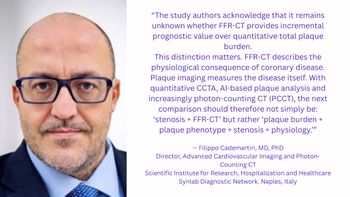
Finally, the shift toward AI-powered coronary plaque quantification (AI-QCT) is redefining cardiovascular risk assessment beyond obstructive stenosis. The CONFIRM2 trial demonstrated that
A Closer Look at Research on Radiation-Induced Cancers with Computed Tomography
While researchers continue to evaluate the potential long-term risks of radiation-induced cancers from CT use, clinicians must weigh these risks against the immediate danger of missing critical diagnoses.
In the first part of
Drs. Cavallo and Mahesh emphasized interpreting these risk models in context and comparing the potential incremental risk of CT radiation with the clinical risk of underlying disease and the diagnostic value of the imaging.
Both Dr. Cavallo and Dr. Mahesh highlighted factors that influence these projections, such as multiphase imaging and subjective clinical decisions about scan necessity. They emphasized that modeling data for radiation-induced cancer projections as modeling data may inform but should not override, individualized decisions about CT utilization and optimization of dosing.
References
- Hall J. Are CT and MRI-derived LI-RADS assessments effective for detecting HCC in cases of non-cirrhotic chronic hepatitis C? Diagnostic Imaging. Available at:
https://www.diagnosticimaging.com/view/ct-and-mri-derived-li-rads-assessments-hcc-non-cirrhotic-chronic-hepatitis-c- . Published March 31, 2025. Accessed December 23, 2025. - An J, Park R, Kim E, et al. LI-RADS for diagnosing hepatocellular carcinoma in patients with noncirrhotic chronic hepatitis C? Radiology. 2025;314(3):e241856. doi: 10.1148/radiol.241856.
- Hall J. Can photon-counting CT be an alternative to MRI for assessing liver fat fraction? Diagnostic Imaging. Available at:
https://www.diagnosticimaging.com/view/photon-counting-ct-alternative-to-mri-assessing-liver-fat-fraction- . Published March 21, 2025. Accessed December 23, 2025. - Dell T, Mesropyan N, Layer Y, et al. Photon-counting CT-derived quantification of hepatic fat fraction: a clinical validation study. Radiology. 2025;314(3):e241677. doi: 10.1148/radiol.241677.
- Hall J. CT-based deep learning model may reduce false positives with indeterminate lung nodules by nearly 40 percent. Diagnostic Imaging. Available at:
https://www.diagnosticimaging.com/view/ct-based-deep-learning-model-reduce-false-positives-indeterminate-lung-nodules-nearly-40-percent . Published September 16, 2025. Accessed December 23, 2025. - Antonissen N, Venkadesh KV, Dinnessen R. External test of a deep lrearning algorithm for pulmonary nodule malignancy risk stratification using European screening data. Radiology. 2025;316(3):e250874. doi: 10.1148/radiol.250874.
- Can AI-enhanced radiomics improve differentiation of pulmonary nodules on chest CT? Diagnostic Imaging. Available at:
https://www.diagnosticimaging.com/view/ai-enhanced-radiomics-differentiation-pulmonary-nodules-chest-ct- . Diagnostic Imaging. Published October 13, 2025. Accessed December 23, 2025. - Zhang H, Liu K, Ding Y, et al. Predictive value of artificial intelligence-based quantitative CT feature analysis for diagnosing the pathological types of pulmonary nodules. Eur Radiol. 2025 Oct 11. doi: 10.1007/s00330-025-12050-w. Online ahead of print.
- Hall J. Study shows merits of CT vascular sign for differentiating solid pulmonary nodules. Diagnostic Imaging. Available at:
https://www.diagnosticimaging.com/view/study-ct-vascular-sign-differentiating-solid-pulmonary-nodules . Published November 7, 2025. Accessed December 23, 2025. - Peng Y, Yin L, Luo TY, Li Q. The value of CT vascular sign in differentiating benign and malignant pulmonary nodules. Acad Radiol. 2025 Nov 7:S1076-5332(25)00986-9. doi: 10.1016/j.acra.2025.10.028. Online ahead of print.
- Hall J. CT-based coronary artery calcium score helps predict post-op survival risks in elderly lung cancer patients. Diagnostic Imaging. Available at:
https://www.diagnosticimaging.com/view/ct-based-coronary-artery-calcium-score-post-op-survival-risks-elderly-lung-cancer-patients . Published April 22, 2025. Accessed December 23, 2025. - Liu Z, Huang L, Tan X, et al. The predictive value of preoperative coronary artery calcium score for long-term survival in elderly patients with lung cancer after surgery. Acad Radiol. 2025;32(7):3903-3914.
- Hall J. Key chest CT parameters for body composition may be prognostic for patients with resectable NSCLC. Diagnostic Imaging. Available at:
https://www.diagnosticimaging.com/view/chest-ct-parameters-body-composition-prognostic-resectable-nsclc . Published February 11, 2025. Accessed December 23, 2025. - Huang Y, Cun H, Mou Z, et al. Multiparameter body composition analysis on chest CT predicts clinical outcomes in resectable non-small cell lung cancer. Insights Imaging. 2025;16(1):32. doi: 10.1186/s13244-025-01910-0.
- Hall J. Can CT-based AI help predict renal function decline after radioligand therapy for mCRPC? Diagnostic Imaging. Available at:
https://www.diagnosticimaging.com/view/ct-based-ai-predict-renal-function-decline-after-radioligand-therapy-mcrpc- . Published February 25, 2025. Accessed December 23, 2025. - Steinhelfer L, Jungmann F, Nickel M, et al. Automated CT measurement of total kidney volume for predicting renal function decline after 177Lu prostate-specific membrane antigen-I&T radioligand therapy. Radiology. 2025;314(2):3240427. doi: 10.1148/radiol.240427.
- Hall J. Why plaque burden is critical to assessing cardiovascular risk: an interview with Ibrahim Danad, MD, PhD. Diagnostic Imaging. Available at:
https://www.diagnosticimaging.com/view/plaque-burden-assessing-cardiovascular-risk-interview-ibrahim-danad-md-phd . Published November 15, 2025. Accessed December 23, 2025. - Hall J. The reading room podcast: current insights on recent research about radiation-induced cancers with CT scans, part 1. Diagnostic Imaging. Available at:
https://www.diagnosticimaging.com/view/reading-room-podcast-current-insights-recent-research-radiation-induced-cancers-ct-scans-part-1 . Published May 2, 2025. Accessed December 23, 2025. - Hall J. What new research reveals about computed tomography and radiation-induced cancer risk. Available at:
https://www.diagnosticimaging.com/view/new-research-computed-tomography-radiation-induced-cancer-risk . Published April 14, 2025. Accessed December 23, 2025. - Smith-Bindman R, Chu PW, Firdaus HA, et al. Projected lifetime cancer risks from current computed tomography imaging. JAMA Intern Med. 2025;185(6):710-719.
Newsletter
Stay at the forefront of radiology with the Diagnostic Imaging newsletter, delivering the latest news, clinical insights, and imaging advancements for today’s radiologists.