
News|Articles|May 26, 2026
Mammography Study Shows Over 20 Percent Increase in Screening for Women in Their 40s After USPSTF Guideline Change
Author(s)Jeff Hall
After the U.S. Preventive Services Task Force (USPSTF) updated its biennial mammography screening recommendations to begin at 40 years of age, women in their 40s accounted for approximately 50 percent of all screening mammography exams, according to new study findings to be presented at the American Society of Clinical Oncology (ASCO) conference.
Advertisement
New research shows the impact of the 2024 changes to the U.S. Preventive Services Task Force (USPSTF) guidelines on mammography screening uptake for women in their 40s.
For the study, to be presented at the upcoming American Society of Clinical Oncology (ASCO) conference, researchers reviewed electronic health record data for 985,687 women between the ages of 40 to 74 who had screening mammography between 2018 and 2025.
The study authors subsequently compared the use of screening mammography prior to and after the aforementioned changes to the USPSTF guidelines that lowered the age of biennial mammography screening to begin at 40 years of age. The researchers noted that 880,685 women were in the pre-guideline group and 105,002 women were in the post-guideline group.
While women in their 40s comprised 29.8 percent of those who had mammography screening prior to the USPSTF guideline change, researchers noted a greater than 20 percent increase in mammography screening uptake for these women after the guideline change (50.7 percent).
“Following the April 2024 USPSTF guideline expansion, screening mammography uptake among women aged 40–49 increased substantially, however the likelihood of a breast cancer diagnosis within 180 days did not significantly differ between the pre- and post-guideline periods,” noted lead study author Karen Farrar, PhD, a senior research analyst at Truveta, and colleagues.
In addition to seeing no statistically significant change with breast cancer for women in their 40s between pre-and post-guideline changes, the study authors also noted no statistical difference in the likelihood of early-stage and late-stage presentation for women diagnosed within three months after screening.
“Stage at diagnosis did not differ significantly in the short post-guideline period; longer follow-up is needed to assess whether earlier detection translates to stage-shift benefits over time,” pointed out Farrar and colleagues.
Reference
- Farrar K, Do D, Masters NB, Cartwright BM. Breast cancer screening and detection after the 2024 USPSTF recommendation for women aged 40-49. Presentation at the American Society of Clinical Oncology (ASCO) conference, May 29-June 2, 2026, Chicago. Available at:
https://www.asco.org/abstracts-presentations/267745 .
Advertisement
Related to this article
In the third of a three-part podcast episode, Wendie Berg, MD, PhD, FACR, FSBI, Manisha Bahl, MD, and Amy Patel, MD discuss recent developments with autonomous AI in breast imaging and share their perspective on the overall potential of AI to help mitigate the radiologist shortage.
In the second of a three-part podcast episode, Wendie Berg, MD, PhD, FACR, FSBI, Manisha Bahl, MD, and Amy Patel, MD discuss how to handle disagreements with adjunctive AI in breast imaging, whether to include AI assessments in PACS, and whether patients should pay for the use of adjunctive AI.
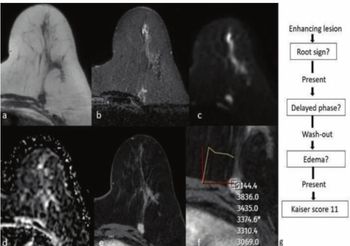
A Kaiser score > 5 with breast MRI demonstrated a 97 percent sensitivity and 87.9 percent specificity for predicting malignancy in patients with BI-RADS 0 or 4 presentations on mammography and breast ultrasound, according to a new study.

In the latest episode of her Breast Imaging in Focus series, Manisha Bahl, MD, MPH, FSBI, discusses new research comparing mammography-based AI models for breast cancer detection and short-term risk prediction.

In a recent interview, Phillip Koo, MD, discussed emerging trends with AI, theranostics and empowered patients, and how these developments may lead to challenges and potential opportunities for radiologists and nuclear medicine physicians.

Catch up on the top radiology content of the past week.
The use of adjunctive CT bone reading software in women with breast cancer detected between 8 to 22 percent more metastatic lesions for reviewing radiologists and reduced CT interpretation time by 50 percent or more, according to a new study.
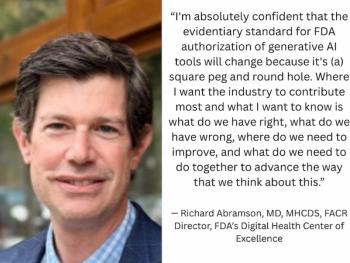
How will generative AI software be evaluated by the FDA in the future? What’s next for point-of-care ultrasound? What steps have been successful in facilitating adoption of AI applications across enterprise systems? Leaders in radiology and health care will be discussing these topics and more at the upcoming HLTH USA conference.
Advertisement
Advertisement
Trending on Diagnostic Imaging
1
FDA Clears Machine Learning Module for Emerging Musculoskeletal Ultrasound Platform
2
Could Photon-Counting CT Have an Impact as a Platform for Molecular Imaging?
3
FDA Clears MRI-Based AI Software for Prognostic Evaluation of Patients with Mild Cognitive Impairment
4
How AI, Theranostics and More Empowered Patients Have Led to Significant Changes in Radiology
5