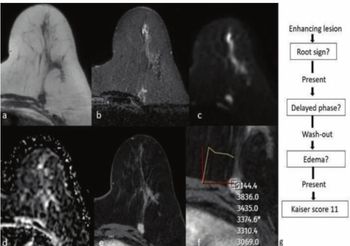
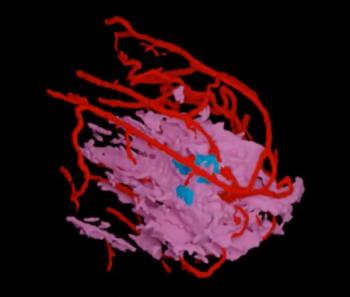
“ … Both ultrafast MRI and conventional DCE-MRI used in our study demonstrated excellent performance in characterizing breast lesions. However, the ultrafast protocol showed lower sensitivity as it missed nine breast cancer lesions out of the 153 malignant lesions, which were in situ carcinomas or lower-grade malignancies (grade 1 IDC or ILC),” wrote lead study author Rasha Karam, M.D., who is affiliated with the Department of Radiology at Mansoura University in El Mansoura, Egypt, and colleagues.
The study authors also found that combining the manually generated parameters of the first ultrafast MRI protocol with the semi-automatically generated parameters of the second ultrafast MRI protocol resulted in higher AUC (94.4 percent vs. 91 percent and 86.9 percent) and sensitivity (80.4 percent vs. 76.5 percent and 76.5 percent) than either protocol alone.
Three Key Takeaways
• Abbreviated/ultrafast breast MRI demonstrated diagnostic performance comparable to conventional DCE-MRI. Ultrafast breast MRI achieved similar sensitivity (90 percent) and a slightly lower AUC (92.1 percent vs. 94 percent) for differentiating malignant from benign breast lesions, while reducing acquisition time to 77 seconds.
• Ultrafast MRI showed lower sensitivity for low-grade disease. Ultrafast MRI missed a small number of cancers that were primarily DCIS or low-grade invasive carcinomas, highlighting a potential limitation when evaluating subtle or indolent malignancies.
Combining manually and semi-automatically derived ultrafast MRI parameters improved performance. This combination yielded higher AUC and sensitivity than either ultrafast protocol alone with parameters that are rapid to generate and feasible for routine clinical use without specialized software.
“To the best of our knowledge, this is the first study to evaluate the efficacy of semiautomatically generated parameters derived from ultrafast MRI in discriminating between benign and malignant lesions, as well as the effect of adding these parameters to the popular TTE and MS parameters on the overall efficacy of the ultrafast protocol,” pointed out Karam and colleagues.
“These parameters were easily derived, rapidly generated, and less complex. They can also be generated routinely by workstations without the need for special software that may only be available in a few MRI centers.”
(Editor’s note: For related content, see “Multimodal AI Model with mpMRI Radiomics Improves Long-Term Post-NAC Survival Prediction,” “New Research Assesses the Impact of Pre-Op MRI on Breast Cancer Recurrence” and “The Reading Room Podcast: Current and Emerging Insights on Abbreviated Breast MRI, Part 1.”)
Beyond the inherent limitations of a single-center study, the authors acknowledged the relatively small number of DCIS cases within the cohort, the lack of comparison of ultrafast breast MRI parameters between mass and non-mass enhancing (NME) lesions as well as a lack of evaluation for differentiating between different molecular subtypes of breast cancers.