Register Now: Image-Based Risk: The Next Frontier in Breast Cancer Screening
|Articles|November 29, 2010

Toshiba takes aim at CT radiation

Author(s)Greg Freiherr

In the battle against patient overdose, Toshiba America Medical Systems brought two weapons to RSNA 2010. One is its Adaptive Iterative Dose Reduction (AIDR), software similar in approach to products from competing CT vendors who use iterative reconstruction to squeeze noise out of their images. The other, Target CTA, is a dose protocol devised specifically for cardiac scans done on the Aquilion One.

In the battle against patient overdose, Toshiba America Medical Systems brought two weapons to RSNA 2010. One is its Adaptive Iterative Dose Reduction (AIDR), software similar in approach to products from competing CT vendors who use iterative reconstruction to squeeze noise out of their images. The other, Target CTA, is a dose protocol devised specifically for cardiac scans done on the Aquilion One.

AIDR made a cameo appearance at the RSNA meeting last year, when it was discussed but not described at any length. It has recently received 510(k) clearance from the FDA and Toshiba is claiming AIDR can achieve dose reductions of as much as 75%.

The new cardiac dose protocol, Target CTA, is a commercial product but designed for use only on patients, including pediatric ones, with stable heart rates. The protocol tailors exposure, which on the Aquilion One is accomplished in a single rotation of the gantry, thanks to the onboard 16-cm-wide detector.

With Target CTA, operators more accurately target the heart, according to Toshiba and, thereby, minimize padding of the scan range that leads to increased patient dose. Used with Toshiba’s advanced SURECardio Prospective, which can reduce radiation dose by up to 80%, Target CTA can lower radiation by another 20%, according to the company.


Related to this article

Key Sessions of Interest for Radiologists at the Upcoming HLTH USA Conference
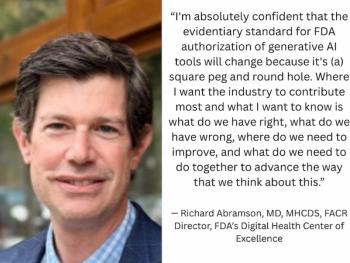
How will generative AI software be evaluated by the FDA in the future? What’s next for point-of-care ultrasound? What steps have been successful in facilitating adoption of AI applications across enterprise systems? Leaders in radiology and health care will be discussing these topics and more at the upcoming HLTH USA conference.