Children’s hospitals use dedicated pediatric technologists and more closely follow protocols, resulting in dramatically lower radiation doses. Adult hospitals must take greater care in monitoring dose. Here’s how.
Children’s hospitals use dedicated pediatric technologists and more closely follow protocols, resulting in dramatically lower radiation doses. Adult hospitals must take greater care in monitoring dose. Here’s how.
Nine months after the first PET/MR hybrid scanner was approved by the FDA, what inroads has the technology made, and should you be adding one to your practice?

Using magnetization transfer ratio (MTR) researchers found a reduction in contrast enhancing lesions, possibly inducing remyelination.

Researchers at Brigham and Women’s Hospital and Tel Aviv University have built a tiny pill camera that would be powered and maneuvered by MRI.
A far quicker MRI scan is on the horizon. A new algorithm developed by MIT’s Research Laboratory of Electronics cuts the imaging time by two-thirds, though they’re still working on the back end processing time. Authors of the research, which is scheduled for publication in the journal Magnetic Resonance in Medicine, say that a 45-minute scan can be done in 15 minutes without compromising much of the quality.
Researchers just found what they said is a cheaper and safer way to diagnose and track Alzheimer’s disease, using arterial spin labeling (ASL), a magnetic resonance imaging (MRI) technique. University of Pennsylvania’s Perelman School of Medicine researchers published twice on the technique this month.
An early treatment MRI can predict a multiple sclerosis (MS) patient’s five-year disability progression, according to a study recently presented in the Netherlands. The study found that by performing an MRI six to 12 months after treatment initiation, it’s possible to predict whether a patient will respond to the given treatment long term.
Radiologists at University of Chicago Medical Center set out to decrease their own error rates, and found that with peers scoring and reviewing each others’ reports, and then discussing them at section meetings, error rates dropped.
Heavy smokers screened for lung cancer with low-dose helical CT scans had a 20 percent lower mortality risk than those screened with standard X-ray, according to a large scale study recently published in the New England Journal of Medicine. So should the lung cancer screening policy change?
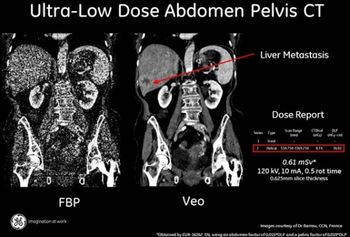
Radiologists have been struggling to balance image noise with radiation dose in computed tomography (CT) scans for decades. But the competition just went up a notch (or perhaps many notches) with the recent FDA approval of GE Healthcare’s Model Based Image Reconstruction (MBIR) technology, Veo. While MBIR is the most recent of the iterative reconstruction technologies, top manufacturers offer their own software answers to the noise versus dose argument.
PET/CT, PET/MR and radiotracers all pushing PET into new applications
Three imaging companies have produced PET/MR technology that are either in the works, or commercially available. Here they are, at a glance.
Participants underwent an MRI exam at the beginning of the study, and again two years later. Researchers also then tested the participants’ memory using several scales. From the memory tests, researchers identified 25 participants (17 percent) whose memory declined during the two years, and 124 participants who did not.
Radiology was one of five specialties which spoke before the Meaningful Use Workgroup of the Office of the National Coordinator for Health Information Technology (ONC), in mid-May. It’s the first time the ONC invited a radiologist to formally participate in this advisory committee hearing.
Researchers found that conventional reports had a mean content satisfaction score of 7.61 out of 10, and a mean clarity satisfaction rating of 7.45. Structured reports scored 8.33 for mean content satisfaction, and 8.25 for clarity. Time to change?
Open design, wide bore, noise reduction MRI machines can ease claustrophobia. Do patients prefer them; are they cost effective; do they improve image quality?
Accrediting organizations urge providers to apply by June 30, 2011. On the first day of 2012, private outpatient imaging centers providing MRI, CT, PET exams and nuclear medicine procedures will need accreditation for Medicare to reimburse for the technical component under Part B of the Medicare Physician Fee Schedule.
It's now possible to diagnose strokes from scans sent to a smart-phone, using a newly developed Candian app. Researchers found that the sensitivity and specificity of detecting intraparenchymal hemorrhage were 100 percent for the iOS device.
Here are some questions you may not have considered, to ask of both the vendors and current users.
Choosing the right financial and billing software system, or the best vendor to outsource billing to, is a critical business decision not to be taken lightly.
Only a few radiologists understand how to make a policy case for the value of diagnostic procedures. More need to contribute to research and prove that continued coverage is worthwhile.
CT colonography is a better screening test than optical colonoscopy (OC), according to a new study published in the May Radiology print issue. Using meta-analysis of studies done over a 15 year period, authors found that the sensitivity of CT colonography for colorectal cancer detection was 96.1 percent, compared with 94.7 percent for OC.
KLAS researchers interviewed more than 500 provider facilities, finding that the regional vendor CoActive scored the highest at 89.4 out of 100.
General practitioners generally find radiology reports helpful. Specialists? A little less so.
Importing radiology exams into a picture archiving and communications system (PACS) after an emergency department (ED) transfer cuts subsequent imaging by up to 17 percent during the first 24 hours, according to a study just released online by Radiology.
You can give doctors decision support advice, but you can't make them take it, according to a new study in the April issue of the Journal of the American College of Radiology.
The reach of portable or compact ultrasound is increasing, with the machines getting smaller, better and more adaptable. In fact, this segment of the market is outpacing the overall ultrasound market.
For a response concerns about nonradiologists using ultrasound technology, we spoke to Christopher L. Moore, MD, assistant professor in the Department of Emergency Medicine at Yale University School of Medicine, who co-authored the New England Journal of Medicine review article behind the initial story.
High utilizers of advanced medical imaging beware: the Medicare Payment Advisory Commission (MedPAC) just voted 15-1 this month to recommend to Congress that the top tier of referrers of advanced medical imaging should get prior authorization first.
The use of CT scans on children in the emergency room has risen more than fivefold since 1995, according to a study coming out this week in Radiology online, to be published in the June print issue.