
Commentary|Videos|November 9, 2026
Assessing the Impact of AI-Powered Slab Reconstruction on Reading Time for Digital Breast Tomosynthesis
Author(s)Jeff Hall
In a recent interview, Carolynn DeBenedectis, MD, discussed the utility of AI-enabled slab reconstruction for interpretation of digital breast tomosynthesis (DBT) and new research showing a 13 percent reduction in reading time.
Advertisement
Recently published research suggests that AI-powered slab reconstruction can significantly reduce average reading time for digital breast tomosynthesis (DBT) without detracting from detection accuracy.
For the study, published in
• a 13 percent reduction in average reading time (54.5 seconds vs. 61.9 seconds)’
• a non-inferior mean AUC (80.9 percent vs. 78.9 percent); and
• a non-inferior mean recall rate for calcification-only cancers (60.5 percent vs. 55.8 percent).
Can Slab Technology Bolster Earlier Detection of DCIS?
In a recent interview with Diagnostic Imaging, lead study author Carolynn DeBenedectis, MD, said that when DBT was first utilized, breast radiologists noted an initial decrease in detection for ductal carcinoma in situ (DCIS). Emphasizing that 90 percent of DCIS presents as subtle calcifications, Dr. DeBenedectis suggested that the slab technology may facilitate easier detection of these calcifications.
“One could hypothesize one of the reasons you don't lose the detection of calcifications is because the slab doesn't make those individual (calcifications) look like they're on individual slices. It makes them look more like a group of calcifications or cluster of calcifications like we look for,” posited Dr. DeBenedectis, a professor of radiology at the UMass Chan Medical School in Worchester, Mass.
What the Study Revealed About 3DQ Software and Reading Time Reduction for DBT
In light of the ongoing challenges with growing imaging volumes and workforce shortages in radiology, Dr. DeBenedectis said the study finding of a 13 percent reduction in reading time with use of the 3DQ software is particularly salient.
“This is the important stuff right now in radiology. We have staffing issues. We have patients waiting in breast imaging months and months for appointments. We have backlogs of screening mammograms. … If we can keep increasing our efficiency while not decreasing our accuracy and keeping our accuracy high, I think it's so important to patient care because we'll be able to see more patients, diagnose them faster and more accurately,” emphasized Dr. DeBenedectis, who is also affiliated with Mass General Brigham.
Advertisement
Related to this article
Catch up on the top radiology content of the past week.
Catch up on the top radiology content of the past week.
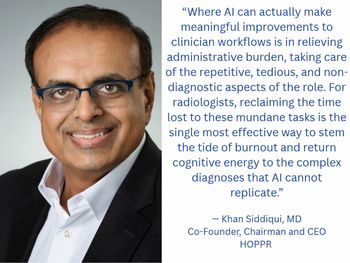
Amid the burgeoning imaging volumes and ongoing radiologist shortage, this author suggests that more active involvement by radiologists in the creation and development of AI models could go a long way.
Catch up on the most-well viewed radiology content in October 2026.

Catch up on the most well-viewed radiology video interviews from Diagnostic Imaging in September 2026.
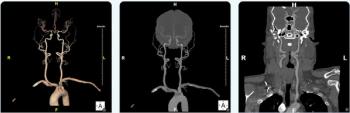
The AI-powered NeuroDR software reportedly removes bone, soft tissue and veins from CTA scans and provides subsequent 3D MIP views and curved planar reformatted views of carotid and vertebral arteries.
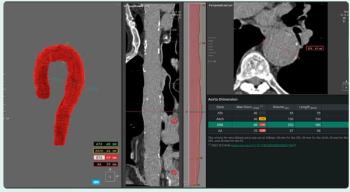
The newly cleared Aview Aorta Metrics software reportedly offers automated segmentation of aortic regions and classification of aortic zones based on chest CT images.
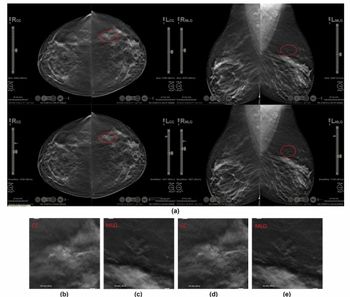
Use of the AI-enabled slab technology from reconstructed DBT imaging led to a 7.4-second mean reduction in reading time in a new study involving 391 cases and 15 reviewing radiologists.
Advertisement
Advertisement
Trending on Diagnostic Imaging
1
New Study Shows Benefits of AI Analysis for Ultrasound Reports and Incidental Findings of Hepatic Steatosis
2
Next-Generation Breast Imaging Platform to be Unveiled at RSNA
3
Diagnostic Imaging’s Weekly Scan: November 1 — November 7
4
What a New Prospective RCT Reveals About Contrast-Enhanced Mammography in Breast Cancer Staging
5