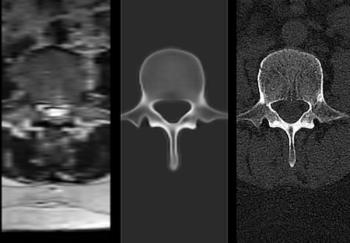
The cloud-based NextMR platform reportedly provides automated 3D bone images of conventional spine MRI images in less than 60 seconds.
In a recent interview, Phillip Kuo, MD, discussed new comparative multicenter prospective research, presented at the SNMMI conference, examining the urinary radioactivity of two PSMA PET radiotracers 18F-piflufolastat and 18F-flotufolastat.
Ureteric radioactivity was present in over three times as many PSMA PET scans with 18F-flotufolastat in comparison to scans obtained with 18F-piflufolastat, according to comparative prospective multicenter research presented at the
For a new subanalysis from a phase 4 prospective trial, researchers compared the urinary radioactivity of 18F-piflufolastat (Pylarify, Lantheus) and 18F-flotufolastat (Posluma, Blue Earth Diagnostics). The cohort was comprised of 55 men (with mean prostate-specific antigen (PSA) value of 0.28 ng/mL) who had biochemical recurrence (BCR) of prostate cancer (PCa) > six months after a radical prostatectomy.
The study authors found no ureteric radioactivity in 69.1 percent of PET/CT scans obtained with 18F-flotufolastat in contrast to 21.8 percent of scans obtained with 18F-piflufolastat.
Employing a three-point scale for qualitative assessment of the radiotracers with respect to urinary radioactivity, the researchers determined that 83.6 percent of 18F-piflufolastat scans had a “2” rating for inhibition of assessment due to urinary radioactivity in comparison to 42.6 percent of 18F-flotufolastat scans.
(Editor’s note: For additional coverage of the SNMMI conference, click
In a recent interview with Diagnostic Imaging, Phillip Kuo, MD, emphasized the value in the combination of quantitative and qualitative data.
“I think that's really the power of this. You have your quantitative data, but you're like, well, we don't sit there and measure numbers as imaging physicians. Then we did the qualitative assessment, and the two, since they're both pointing at the same thing, really support each other. That's really how you should look at this data, in both ways, to make sure that everything is really aligning, and it did in these studies,” emphasized Dr. Kuo, who is affiliated with Kuo Radiology LLC.
Dr. Kuo emphasized the importance of urinary radioactivity as a key consideration with the use of radiotracers for PSMA PET imaging.
“One of the issues with PET is that there's really intense activity in an area we can get a blooming effect where the activity goes outside the confines of where the disease is, or the organ, and can obscure adjacent disease. So (it is a) very much a relevant point in PSMA PET as to how (the radiotracer) distribution and their clearance can affect your sensitivity when trying to assess for prostate cancer and its metastatic disease,” maintained Dr. Kuo.
(Editor’s note: For related content, see “
References
2. Kuo P, Sykes J, Penny R, Cohen T. Intra-patient contemporaneous comparator study of normal-organ distribution of PSMA-targeting PET radiopharmaceuticals, 18F-piflufolastat and 18F-flotufolastat, in patients with low PSA biochemical recurrence of prostate cancer after radical prostatectomy. Presented at the Society of Nuclear Medicine and Molecular Imaging (SNMMI) conference, May 30-June 2, 2026, Los Angeles. Available at: