
Commentary|Articles|August 6, 2026
Thirteen Takeaways on BI-RADS v2025 Changes for Mammography, Ultrasound and Breast MRI Reporting
Author(s)Jeff Hall
In a recently published review of the BI-RADS v2025 manual, leading breast radiologists offered pertinent insights on key changes for reporting of mammogram, breast ultrasound and breast MRI interpretation and assessment.
Advertisement
Whether it is changes with calcification descriptors for mammogram review, new guidance for lymph node reporting, non-mass lesions on breast ultrasound and peritumoral edema on breast MRI, leading breast radiologists offer practical insights on all of the changes for the BI-RADS v2025 manual in a newly published review in the
Here are 13 pertinent takeaways from the review.
What Were Key Mammography Changes for BI-RADS v2025?
- Masses no longer require confirmation on two projections. BI-RADS v2025 explicitly allows a suspicious finding seen on a single digital breast tomosynthesis (DBT) projection to be described as a mass, reflecting DBT's depth resolution and its now central role in mammographic interpretation.
2. Mass and calcification descriptors were reorganized to reduce ambiguity. "Microlobulated" was removed as a margin descriptor and "lobulated" was added as a shape descriptor. Architectural distortion and lymph nodes are now described as separate associated features rather than being grouped together. "Developing asymmetry" was eliminated as a standalone category with interval change now described more narratively.
3. A new approach for calcification descriptors. Emphasizing morphology and distribution, the BI-RADS v2025 system reorganizes the terminology for calcification descriptors in order to facilitate improved clarity in risk stratification and enhance reproducibility among readers.
4. While retaining the four breast density categories, the BI-RADS v2025 system emphasizes more of a focus on the densest region of the breast as opposed to an overall fibroglandular percentage. The BI-RADS v2025 system also requires density reporting on certain post-procedure mammograms (e.g., after clip placement) when reported separately from other exams.
5. Improved clarity for the BI-RADS category 0 assessment. Identifying whether this assessment is due to a need foradditional imaging evaluation versus a need for prior images for comparison may help reduce ambiguity for technologists, referring clinicians, and in outcomes tracking as well.
6. Enhanced guidance for lymph node reporting. For mammography reporting, a separate section for nodal evaluation — instead of previous notation in the “associated feature” section — may facilitate more systematic description of nodal morphology and laterality.
7. An updated guidance on dilated ducts. Offering separate categories for solitary and multiple dilated ducts, the BI-RADS v2025 system also emphasizes differentiation between benign dilated ducts and ductal dilatation that appears suspicious based upon laterality, associated calcifications, or other concerning features.
What Are the Pertinent Breast Ultrasound Updates with BI-RADS v2025?
8. New shape, echo pattern, and elasticity descriptors were added.The BI-RADS v2025 system adds “lobulated” as a shape descriptor for ultrasound and replaces “complex cystic and solid” with “mixed solid and cystic” as the most suspicious echo pattern descriptor. Newly incorporated elasticity descriptors are also noted in the updated BI-RADS v2025 system.
9. Non-mass lesion has been added for ultrasound findings with an emphasis on distribution, echo pattern, and posterior feature descriptors. The BI-RADS v2025 system also recognizes segmental distribution of a non-mass lesion as prognostic for malignancy.
10. Expanded guidance on lymph node and tissue composition. Nodal discussion is now inclusive of internal mammary and supraclavicular nodes as well as intramammary and axillary nodes. The BI-RADS v2025 system also added a new descriptor with glandular tissue component (GTC), a quartile-based qualifier of fibroglandular tissue. A moderate to marked GTC is associated with a 50 percent increased cancer risk relative to minimal to mild GTC, according to the BI-RADS v2025 system.
11. Calcification and associated feature terminology were updated for ultrasound. Calcifications are now subdivided into macrocalcifications and microcalcifications in the BI-RADS v2025 system. A new descriptor, “
What Does BI-RADS v2025 Change About Breast MRI Reporting?
12. Key terminology changes. For mass presentations on breast MRI, the BI-RADS v2025 system added “lobulated” as a shape descriptor and changed “irregular” to “indistinct” for margin descriptions. Other changes included the addition of “thick” to denote uneven thick rim enhancement and the use of T2 signal intensity as a mass descriptor.
13. Revision of associated features. The BI-RADS v2025 system has removed architectural distortion as an associated feature for breast MRI and replaces “invasion” with “involvement” when describing extended enhancement into extended structures. A new associated feature is
Advertisement
Related to this article
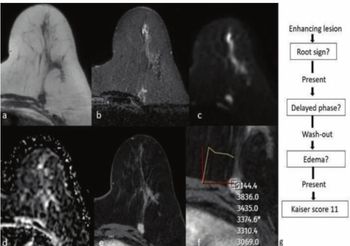
A Kaiser score > 5 with breast MRI demonstrated a 97 percent sensitivity and 87.9 percent specificity for predicting malignancy in patients with BI-RADS 0 or 4 presentations on mammography and breast ultrasound, according to a new study.

Catch up on the top radiology content of the past week.
In the second of a three-part podcast episode, Wendie Berg, MD, PhD, FACR, FSBI, Manisha Bahl, MD, and Amy Patel, MD discuss how to handle disagreements with adjunctive AI in breast imaging, whether to include AI assessments in PACS, and whether patients should pay for the use of adjunctive AI.
Catch up on the top radiology content of the past week.
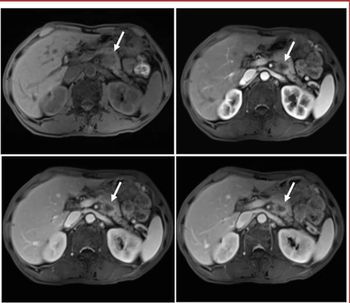
Magnetic resonance imaging offered a 29 percent higher sensitivity than CT for differentiating liver metastases, but CT provided 12 percent higher sensitivity than MRI for assessing vascular invasion, according to a new 40-study meta-analysis.
Catch up on a variety of FDA news in radiology from the past week.
Catch up on the top radiology content of the past week.
Catch up on the top radiology content of the past week.
Advertisement
Advertisement
Trending on Diagnostic Imaging
1
Study Shows PCCT Offers Higher Image Quality and Reduced Radiation Dosing than EID-CT in Obese Patients
2
FDA Clears Machine Learning Module for Emerging Musculoskeletal Ultrasound Platform
3
FDA Clears AI-Enabled FFR-IQ Software for Estimating Fractional Flow Reserve from CCTA
4
Radiology Roundup of FDA News: October 18 — October 24
5