

Commentary|Podcasts|October 21, 2026
The Reading Room Podcast: Emerging Concepts with AI Integration in Radiology
Author(s)Jeff Hall
In a new podcast episode, Joseph Cavallo, MD, MBA, offered his perspective on AI integration, potential efficiency gains, navigating post-deployment monitoring and how to incorporate AI literacy into radiology resident training.
Advertisement
While post-deployment monitoring of AI tools in radiology can be challenging, Joseph Cavallo, MD, MBA, noted key steps they have taken at the Yale University School of Medicine to address this issue.
In a
“This helps clear up confusion if the referring providers see some of the AI-generated notations or alerts within the PACS system themselves, since everybody has access to the PACS images now. It also helps us from a tracking standpoint if we wanted to be able to see within the reports, not just the external AI data, where we're disagreeing with an AI finding,” explained Dr. Cavallo, an assistant professor of radiology and biomedical imaging at the Yale University School of Medicine.
For radiology educators, Dr. Cavallo said there is a balancing act with the increasing advent of AI in radiology. Ensuring an “ironclad” clinical foundation remains essential in the training of residents and fellows. However, Dr. Cavallo says incorporating data literacy concepts is important to show upcoming radiologists how to appropriately leverage AI tools while being wary about potential automation bias and deskilling.
“AI is becoming an integral part of the radiologist workflow, and the onus is on the trainers to make sure that the residents and fellows are well versed with these tools and are in a position to leverage them themselves moving forward. We've made some internal decisions to try and balance those two forces, and I'm sure different institutions are handling it differently,” noted Dr. Cavallo, an assistant director of informatics for clinical artificial intelligence in radiology at the Yale University School of Medicine.
For more insights from Dr. Cavallo, listen below or
(Editor’s note: This podcast was originally published as a video interview at the following link:
Advertisement
Related to this article
In the second of a three-part podcast episode, Wendie Berg, MD, PhD, FACR, FSBI, Manisha Bahl, MD, and Amy Patel, MD discuss how to handle disagreements with adjunctive AI in breast imaging, whether to include AI assessments in PACS, and whether patients should pay for the use of adjunctive AI.
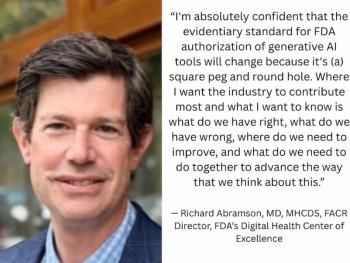
How will generative AI software be evaluated by the FDA in the future? What’s next for point-of-care ultrasound? What steps have been successful in facilitating adoption of AI applications across enterprise systems? Leaders in radiology and health care will be discussing these topics and more at the upcoming HLTH USA conference.
In the third of a three-part podcast episode, Wendie Berg, MD, PhD, FACR, FSBI, Manisha Bahl, MD, and Amy Patel, MD discuss recent developments with autonomous AI in breast imaging and share their perspective on the overall potential of AI to help mitigate the radiologist shortage.
Catch up on the top radiology content of the past week.
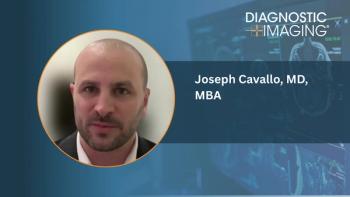
In a recent interview with Diagnostic Imaging, Joseph Cavallo, MD, MBA, offered insights on post-deployment monitoring with AI, the potential for improved workflow efficiency and the ongoing challenge of balancing essential clinical skills and AI literacy in the training of radiology residents and fellows.
In the first of a three-part podcast episode, Wendie Berg, MD, PhD, FACR, FSBI, Manisha Bahl, MD, and Amy Patel, MD share insights on the utility of AI in breast imaging with respect to potential advantages, current concerns and future directions.
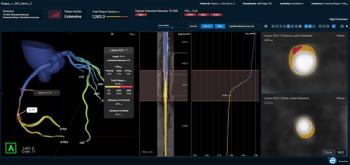
The FFR-IQ software recently demonstrated a 92.2 percent sensitivity for non-invasive estimation of fractional flow reserve (FFRC) based on coronary CT angiography (CCTA) scans.
In a recent interview, Francesco Giganti, MD, PhD, discussed findings from a recent multicenter study demonstrating the ability of an AI software to provide significant clarity to initial PI-RADS 3 assessments on MRI and facilitate a nearly 19 percent reduction in unnecessary prostate biopsies.
Advertisement
Advertisement
Trending on Diagnostic Imaging
1
FDA Clears MRI-Based AI Software for Prognostic Evaluation of Patients with Mild Cognitive Impairment
2
Can MRI-Based AI Have an Impact in Reducing Unnecessary Prostate Biopsies?
3
FDA Clears AI-Enabled FFR-IQ Software for Estimating Fractional Flow Reserve from CCTA
4
The Reading Room Podcast: A Closer Look at New Research on 177Lu-Edotreotide for Treating GEP-NETs
5