










What’s happening with the American Roentgen Ray Society? Its annual meeting, known mainly for the quality of its refresher course, has become an essential point of coverage for world-class scientific research as well.

What’s happening with the American Roentgen Ray Society? Its annual meeting, known mainly for the quality of its refresher course, has become an essential point of coverage for world-class scientific research as well.

A preliminary study indicates that first-pass and delayed-enhancement myocardial CT correlate well with measures of infarction size gathered with equivalent cardiac MR procedures.

Dr. Fred L. Steinberg and his imaging centers and related entities in Palm Beach County near Miami will pay $7 million to settle alleged violations of federal Stark self-referral law and anti-kickback statutes. He was also charged with billing fraud.

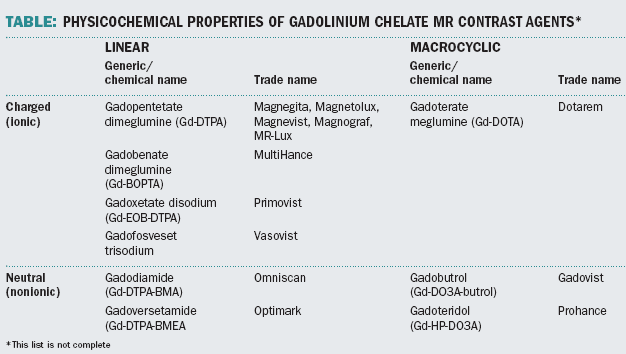
New evidence has surfaced pinpointing specific potential causes of nephrogenic systemic fibrosis. Findings sustain its relationship to some gadolinium-based contrast media, but they also suggest that infection, certain patient demographics, and even some drugs could be strongly associated with the condition.

Widespread muscle and tissue pain, tenderness, and fatigue are well-documented symptoms of fibromyalgia, a chronic condition that affects up to an estimated 6% of the U.S. population. The underlying pathology of the pain disease is unknown. A new study featuring proton MR spectroscopy, however, has found a key linkage between the pain and a specific brain molecule.

A recent “Sentinel Alert” from the Joint Commission addressing the prevention of accidents and injuries in the MRI suite stated:

Nephrogenic systemic fibrosis has received widespread attention, but official protocols on how to avoid the life-threatening skin condition are quite sparse: Only one section in the American College of Radiology’s 2007 white paper on safe MR practices is devoted to the condition.

Force feedback shows potential for tissue segmentation and interventional planning


Protocol Could Widen Three-Hour Treatment Window


Reduced access to radiologists forces self-reliance for patient care and preoperative surgical planning

Traditional reliance on physical symptoms leads to surgery after heart has already been damaged

Cardiac CT reimbursement controversy underscores growing demand for definitive trials that establish efficacy of emerging technologies

Good results require thorough patient preparation, dual positioning during imaging, and experienced readers

Monitoring water mobility offers an approach to cancer imaging that complements anatomy-based techniques

Any fluid-filled cavity or sac that is lined by an epithelium is a cyst, and intracranial cystic lesions are a common finding on CT and MR imaging of the brain.1,2 These lesions contain either cerebrospinal fluid, fluid that is similar to CSF, mucus, or proteinaceous fluid. They are lined by epithelial cells, inflammatory cells, or glial cells. The attenuation characteristics of the cyst on CT and MRI and the contrast enhancement patterns depend on the cyst's contents and the composition of the wall.

Results from two clinical trials demonstrate that cryoablation of renal cell carcinomas is effective at least a year after treatment in nearly all patients with lesions 4 cm or smaller. The studies suggest that cryotherapy could serve as an alternative to surgery.

The discovery process for more than 60 federal lawsuits alleging a connection between cases of nephrogenic systemic fibrosis and gadolinium-based MR contrast agents will be consolidated at a single district court in Ohio, according to a U.S. judicial panel. Centralization will accelerate the discovery process and give plaintiffs access to a wider pool of pretrial information.

Give me a good gadget and I’m happy. I think a lot of people in radiology would say the same thing. It’s the reason crowds gathered 15 years ago to see 3D reconstructions revolving aimlessly in space. It’s why MR was a hit in the early 1980s.

Cardiac MR imaging with delayed gadolinium enhancement can detect silent myocardial fibrosis and other cardiac abnormalities in patients with systemic sclerosis, German researchers told attendees of a cardiac session in Vienna.

Whole-body MRI is more sensitive but less specific than FDG-PET/CT for cancer detection, according to researchers from China and Europe. Findings suggest a complementary rather than exclusive role in oncologic imaging for both modalities and validate recent studies suggesting close follow-up since either test can miss metastases.

Marathon runners 50 years or older may face a higher than expected risk of sudden cardiovascular accidents. MR imaging with late gadolinium enhancement may help identify these athletes in time to keep them from potentially deadly episodes, according to German researchers reporting at the 2008 European Congress of Radiology in Vienna.

The relationship between gadolinium-based contrast media for MRI and nephrogenic systemic fibrosis may be more nuanced than previously thought, according to several studies presented Friday at the 2008 ECR.