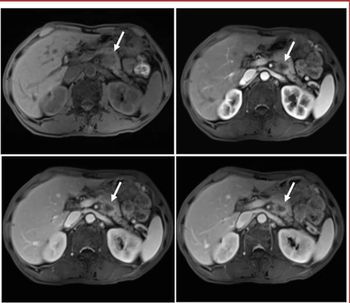
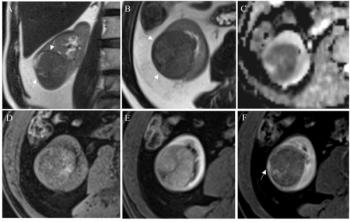
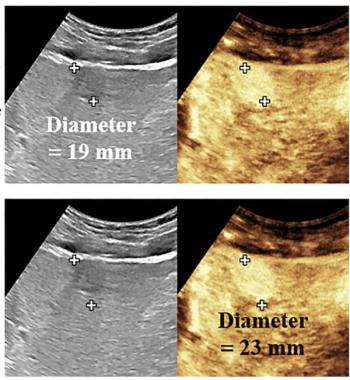
“These findings suggest that Kupffer-phase hypoenhancement could make PFB CEUS a potential alternative to MRI. Variations in performance among contrast agents and diagnostic criteria reflect a flexible diagnostic toolkit that can be tailored to local and regional priorities for high specificity or sensitivity,” noted Yu Li, M.D., who is affiliated with the Department of Ultrasound at Sun Yat-sen University Cancer Center in Guangzhou, China, and colleagues.
Three Key Takeaways
- PFB-CEUS (Strategy B) approaches MRI-level performance for small HCC nodules.
CEUS strategy B (incorporating Kupffer-phase hypoenhancement) demonstrated comparable sensitivity and specificity to MRI for detecting small HCC, suggesting it may serve as a viable alternative in high-risk patients.
- Adding Kupffer-phase hypoenhancement improves diagnostic performance. Compared with strategy A CEUS, strategy B CEUS improved sensitivity (65.9 percent vs. 57.1 percent) and accuracy without sacrificing specificity, and appropriately upgraded a number of LR-4 nodules to LR-5, most of which were pathologically confirmed as HCC.
- Kupffer-phase imaging enhances lesion conspicuity. PFB contrast enables visualization of Kupffer-phase hypoenhancement, which was present in over 90 percent of HCC nodules — higher than the rate of non-peripheral washout seen on MRI — supporting its diagnostic value in characterizing small lesions.
After utilizing CEUS strategy B with the inclusion of Kupffer-phase hypoenhancement, the study authors found that 25 nodules characterized as LR-4 presentations with CEUS strategy A were upgraded to LR-5 assessments. The researchers pointed out that 22 of the nodules (88 percent) were subsequently confirmed as HCC upon pathologic analysis.
The researchers also pointed out that Kupffer-phase hypoenhancement on CEUS was noted in 92.1 percent of HCC nodules whereas non-peripheral washout on MRI occurred with 83.3 percent of HCC nodules. The study authors noted that the use of PFB facilitates visualization of Kupffer-phase hypoenhancement.
“Perfluorobutane (PFB), in addition to vascular phase, is selectively phagocytosed by Kupffer cells in hepatic parenchyma, resulting in sustained enhancement of liver parenchyma more than 10 minutes after contrast injection (Kupffer phase), in which lesions devoid of functioning Kupffer cells show a hypoenhancement on imaging,” added Li and colleagues.
(Editor’s note: For related content, see “Multicenter Study Affirms Value of Updated AASLD Criteria for Surveillance of Hepatocellular Carcinoma,” “Can Ultrasound-Derived Fat Fraction Provide a Viable Alternative for Quantifying Hepatic Steatosis?” and “Key MRI Findings Predictive of Treatment Response for Unresectable Hepatocellular Carcinoma.”)
In regard to study limitations, the authors acknowledged that the findings were drawn from a hepatitis B-predominant cohort, thwarting application to broader populations with different risk factors for HCC. The researchers also conceded the use of non-matched cohorts with and without cirrhosis.