

Blog|Articles|August 10, 2026
The Weight of Numbers in Radiology
Author(s)Eric Postal, MD
Getting caught up in the numbers of cases we’re reviewing may increase stress and inhibit our productivity.
Advertisement
Way back when, as a high school freshman, I started running on track and field and cross-country racing teams. It was the result of something between parental encouragement and coercion. Looking back, I have long since been able to see that it was an unquestionably good thing for me, but if you had asked teenage me what he thought, he would express considerably less enthusiasm.
I was a distance runner, and that was a lot more interesting for cross-country than it was on a track. In cross-country (I am told it is now abbreviated as XC), one deals with much more open space. You might only have to complete a single circuit on the route whereas at a typical track meet, the long run means eight times around a much smaller oval.
It never really hit me just how much more wearing the latter was until we competed at a school that had minimal acreage, and thus an eighth-mile track rather than the quarter miles we were used to doing. We went the same distance but now it took 16 laps instead of eight and that made things brutal. It might have been when I started thinking I had enough of track.
During subsequent decades, I have seen the same phenomenon carried out in many other venues. If you break a task into ever smaller increments to the point where you are increasingly aware of their passage, it can be kryptonite to your endurance.
I have seen it in other aspects of running, for instance looking at a timer or odometer while you are on a treadmill. The more frequently I check to see how long I have been going, how much I have got left to go, etc., the tougher it gets. It also happens if you look at a clock too much while waiting for something to happen, a la the “watched pot” taking longer to boil.
It is something I am reminded of when I hear talk of efficiency tools, AI included, promising to improve productivity in radiology as well as other fields. That is put forth as one of the optimistic scenarios of how new technology will impact us. We’ll be able to do so much more and be better at it! (This would be in contrast to the perception that radiologists will be completely replaced by machines.)
I find myself wondering just how utopian that would really be. Today, my platform and case mix (mostly body CT/MR, a mix of oncological and ER stuff) have me doing around six cases per hour. How would it feel if new tools pushed me to 12?
Being per-click, I might just get dollar signs in my eyes and say it would be wonderful. On the other hand, I can imagine those new tools having hefty price tags, and me getting paid less per case to cover the cost. Eventually, I can also envision insurers and CMS responding to the “new normal” by cutting reimbursements to the point that my income goes back to baseline or below.
Meanwhile, my sense of self as a rad has been at the six-scans-per-hour level for quite some time. If you double that, you are doubling the work increments of my day, just like when I moved from an eight-lap race to 16. That has got to be mentally fatiguing. The amount of work I am doing (as opposed to the AI) might not change, but there is a certain psychological weight to the number of cases that I am clicking through.
I have already seen this to a certain extent, moving from one job to another. My worklists haven’t always been purely cross-sectional. There was even a job where I was specifically assigned a glut of x-rays. Sometimes I topped 30 per hour even with a couple of scans thrown in to the mix.
Yes, there was a certain sense of “Wow, look what I can do!” but I had previously been doing 10 to 12 cases per hour with a fraction of the XR load. The bigger numbers had me feeling like I was constantly hustling, even if any given case required far less of my mental capacity. If there were any way to objectively measure my stress-per-RVU, guaranteed it was head and shoulders above anything I had done before.
Maybe rads would self-correct for that. Suppose new tools could double a typical rad’s output, but the weight of numbers threatened to inflict rapid burnout. If we recognized this, maybe we would proactively pump the brakes on ourselves. Instead of going from productivity X to 2X, we gravitate to 1.75.
That might not make the bean-counters happy, but it could delay retirement for a lot of us. Having a larger population of 1.75ers would probably be better for everyone than an even more severe shortage of rads in the field, double production notwithstanding.
Advertisement
Related to this article

Has the barrage of passwords, PINs and authenticator apps gone around the bend to a point where it hampers efficiency and productivity?
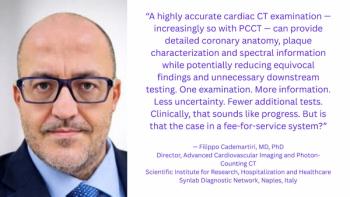
While better imaging may reduce the need for additional diagnostic tests, it may also eliminate the reimbursement that comes with those additional tests.
Could a la carte pricing be a consideration in improving revenue for radiologists in private practice?
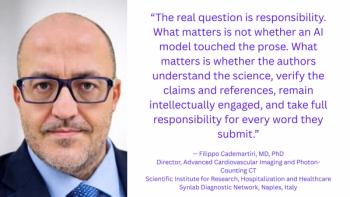
While AI offers the lure of efficiency and cleaner writing in scientific research, maintaining the principles of authorship and intellectual engagement is perhaps more important than ever before.

Does fractional flow reserve (FFR) or quantitative plaque burden from CCTA provide greater prognostic insight into coronary disease?
Constant grumbling from an attending radiologist about the road ahead may be a sign that his or her best teaching years may be in the rear-view mirror.
In the third of a three-part podcast episode, Wendie Berg, MD, PhD, FACR, FSBI, Manisha Bahl, MD, and Amy Patel, MD discuss recent developments with autonomous AI in breast imaging and share their perspective on the overall potential of AI to help mitigate the radiologist shortage.

In a recent interview, Amir Iravani, MD, FRACP, discussed the radiotherapeutic agent 177Lu-edotreotide and new dosimetry data from the COMPETE trial that was recently presented at the ASTRO conference.
Advertisement
Advertisement
Trending on Diagnostic Imaging
1
What New Dosimetry Data Reveals About 177Lu-Edotreotide for GEP-NET Treatment
2
The Reading Room Podcast: Current Perspectives, Challenges and Possibilities with AI in Breast Imaging, Part 3
3
FDA Clears AI-Powered Platform for Converting Spine MRIs to 3D Visualizations
4
FDA Clears MRI-Based AI Software for Body Composition Analysis
5