Catch up on the top radiology content of the past week.
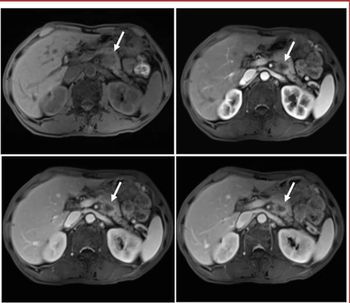
Software to aid in the evaluation of hepatic lesions debuted June 7 at the Society for Imaging Informatics in Medicine meeting in Providence. The IQQA(R)-Liver Enterprise, developed by EDDA Technology, enables 4D analyses running on existing PACS workstations. The software handles the large volume of data obtained from contrast-enhanced multislice images of the liver. It automatically performs anatomic phase registration to visualize and cross-reference lesion locations and characteristics across different phases of enhancement. Segmentation and measurement tools address lesions, vascular structures, and lobes of the liver.
Software to aid in the evaluation of hepatic lesions debuted June 7 at the Society for Imaging Informatics in Medicine meeting in Providence. The IQQA(R)-Liver Enterprise, developed by EDDA Technology, enables 4D analyses running on existing PACS workstations. The software handles the large volume of data obtained from contrast-enhanced multislice images of the liver. It automatically performs anatomic phase registration to visualize and cross-reference lesion locations and characteristics across different phases of enhancement. Segmentation and measurement tools address lesions, vascular structures, and lobes of the liver.