The Biggest Mistake with AI in Radiology
While AI tools abound in radiology, how many AI-enabled software products have incorporated insights from clinical radiologists?
A new technology arrives. Everyone gets excited. Everyone starts building. There are detection algorithms, reporting assistants, workflow tools, integration layers and hospital “AI platforms.” Everyone optimizes a piece. Almost nobody designs the system.
Hospitals develop their own solutions, sometimes without seriously asking what already exists, who tried it before, who succeeded, who failed miserably, and why.
Then prototypes become infrastructure. Infrastructure requires integration, validation, cybersecurity, maintenance, updates, personnel and support. Costs explode.
And sometimes the math simply doesn’t hold.
Meanwhile, at the end of this enormously complicated pipeline sits someone we strangely forget to involve at the beginning.
The clinical radiologist.
Experienced radiologists know where workflows actually hurt. They know which repetitive tasks consume time without generating value, where information gets lost, where expertise matters and what should not be automated.
So perhaps we are starting with the wrong question. We shouldn’t ask: “What can AI do?’ The key question is “What should radiology become?”
Then work backwards.
• What should we automate today?
• Where can AI reduce friction and cost?
• Where can it improve quality and throughput?
• Where can it protect clinical value?
• Where can it fundamentally redesign the workflow?
Making radiologists slightly faster at doing exactly what they already do is a remarkably small ambition.
The real opportunity is to move from image interpretation toward clinical information integration: images, quantitative biomarkers, priors, laboratory results, clinical data and longitudinal disease trajectories.
We don’t have an AI shortage.
We have an architecture shortage, a workflow design shortage and, sometimes, a common sense shortage.
Before building the next “AI ecosystem,”
• Talk to the people doing the job.
• Study what has already been built.
• Understand what has already failed.
• Design the system.
• Then choose the technology.
Otherwise, we may end up with thousands of brilliant AI tools and very few truly intelligent radiology departments.
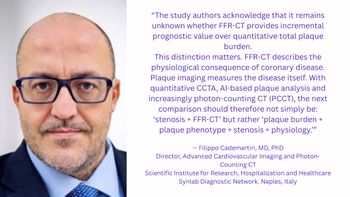
Dr. Cademartiri is the director of advanced cardiovascular imaging and photon-counting CT at the Scientific Institute for Research, Hospitalization, and Healthcare Synlab Diagnostic Network in Naples, Italy. He is also a consultant in advanced cardiovascular imaging at CDI/Centro Diagnostico Italiano in Milan, Italy.
(Editor’s note: This blog is adapted with permission from Dr. Cademartiri’s original LinkedIn post at
Related to this article