FDA Clears Software That Combines MRI Enhancement of PET Imaging with Automated Quantification of Amyloid and Tau PET
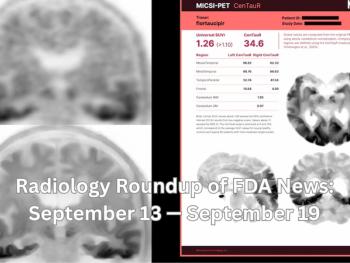
Incorporating structural MRI to improve PET imaging resolution, the MICSI-PET software also offers automated Centiloid quantification from amyloid PET scans.
The Food and Drug Administration (FDA) has granted 510(k) clearance for the MICSI-PET software, which reportedly facilitates enhanced image quality and provides automated quantification for tau and amyloid positron emission tomography (PET) scans.
Microstructure Imaging (MICSI), the developer of
• incorporation of structural MRI to enable denoising of PET images and improved image quality;
• automated Centiloid quantification for amyloid PET;
• automated CenTauR quantification for tau PET; and
• comparison of regional SUVr measurements and z-scores with normative controls.
“The difference can be dramatic in borderline amyloid cases,” noted Lawrence N. Tanenbaum, MD, FACR, a neuroradiologist and imaging technology advisor. “When you’re trying to determine whether there is true cortical sparing, MICSI-PET can make the pattern substantially easier to see. Adding automated quantification to that improved visualization gives the reader a much more powerful way to evaluate the examination.”
Related to this article