

Blog|Articles|June 12, 2026
The Hidden Social Price of Remote Work in Radiology
Author(s)Filippo Cademartiri, MD, PhD
New research suggests the silent accumulated social costs of remote work are outweighing the benefits of increased flexibility and autonomy.
Advertisement
Remote work may be the most popular social experiment that nobody ever measured.
For years, the discussion around remote work has been dominated by a few questions: Are people productive? Do they save commuting time? Do they prefer it?
Almost nobody asked a more fundamental question: What happens when you remove work as a source of human contact?
A new Science paper analyzed more than 588,000 individuals and found that workers in remote-compatible occupations experienced:
• More time spent alone
• Less social interaction
• More psychological distress
• More mental health consultations
• More antidepressant and anxiolytic prescriptions1
The effect was particularly severe among people living alone.
The accompanying Perspective article makes an even more interesting argument.2 For decades, we have thought of work as an economic activity. Maybe that was incomplete. Work is also social infrastructure.
The office was never just a place where people worked.It was a place where people accidentally met, a place of weak ties, a place of spontaneous conversations, a place of low-cost social interaction, and a place where society happened.
The paradox is striking. Workers consistently say they prefer remote work. Yet the same workers appear to become more isolated over time.
Granted, the benefits are immediate.
• No commute
• More flexibility
• More autonomy
However, the costs accumulate silently.
• Fewer interactions
• Weaker social networks
• Greater isolation
The modern workplace may have been producing a valuable social good without anybody accounting for it. Now we are discovering what happens when that infrastructure disappears.
The lesson may not be that remote work is bad.The lesson may be that we have massively underestimated the biological importance of everyday human contact.
Flexibility is valuable but humans are still a social species, and Zoom was never designed to replace society.
In an interesting side note, the study authors estimate that remote work may explain roughly one-third of the increase in mental distress observed in the study period, which is a surprisingly large population-level effect if confirmed by future work.
Dr. Cademartiri is the director of advanced cardiovascular imaging and photon-counting CT at the Scientific Institute for Research, Hospitalization, and Healthcare Synlab Diagnostic Network in Naples, Italy. He is also a consultant in advanced cardiovascular imaging at CDI/Centro Diagnostico Italiano in Milan, Italy.
References
- Emanuel N, Harrington E, Pallais A. Home alone: remote work, isolation, and mental health. Science. 2026 Jun 4;392(6802):eaec7671. doi: 10.1126/science.aec7671. Epub 2026 Jun 4.
- Zang E, O’Brien R. The lost social infrastructure of work. Science. 2026 Jun 4;392(6802):1025-1026. doi: 10.1126/science.aeh9559. Epub 2026 Jun 4.
(Editor’s note: This blog is adapted with permission from Dr. Cademartiri’s original LinkedIn post at:
Advertisement
Related to this article

Has the barrage of passwords, PINs and authenticator apps gone around the bend to a point where it hampers efficiency and productivity?
While better imaging may reduce the need for additional diagnostic tests, it may also eliminate the reimbursement that comes with those additional tests.
While the allure of partnership or a hierarchical promotion system for those who paid their dues once sounded promising, the current reality amid declining reimbursements, thinning practice margins and private equity acquisitions is going after the gig with the most optimal lifestyle and paycheck.
How will generative AI software be evaluated by the FDA in the future? What’s next for point-of-care ultrasound? What steps have been successful in facilitating adoption of AI applications across enterprise systems? Leaders in radiology and health care will be discussing these topics and more at the upcoming HLTH USA conference.
In the third of a three-part podcast episode, Wendie Berg, MD, PhD, FACR, FSBI, Manisha Bahl, MD, and Amy Patel, MD discuss recent developments with autonomous AI in breast imaging and share their perspective on the overall potential of AI to help mitigate the radiologist shortage.
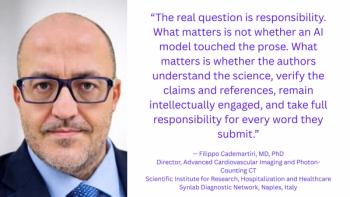
While AI offers the lure of efficiency and cleaner writing in scientific research, maintaining the principles of authorship and intellectual engagement is perhaps more important than ever before.
In the second of a three-part podcast episode, Wendie Berg, MD, PhD, FACR, FSBI, Manisha Bahl, MD, and Amy Patel, MD discuss how to handle disagreements with adjunctive AI in breast imaging, whether to include AI assessments in PACS, and whether patients should pay for the use of adjunctive AI.

Catch up on the top radiology content of the past week.
Advertisement
Advertisement
Trending on Diagnostic Imaging
1
What a Large Prostate MRI Study Reveals About AI and Unassisted Radiologist Assessment
2
MRI Study Links Tightness of High-Convexity Sulci to Higher Risk of Cognitive Decline in Older Adults
3
Breast Imaging in Focus: Can AI Models for Breast Cancer Detection and Risk Prediction Be Used Interchangeably?
4
Research Highlights from the ASTRO 2026 Annual Meeting
5