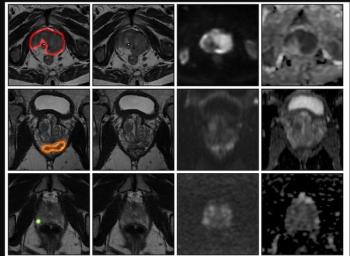
“Substitution of PI-RADS by UNet-Likert scores demonstrated tendencies for improvement but combining PI-RADS with UNet-probability demonstrated improved discrimination and net benefit, suggesting extraction of complementary information from imaging,” wrote lead study author Adrian Schrader, M.D., who is affiliated with the Division of Radiology at the German Cancer Research Center in Heidelberg, Germany, and colleagues.
The study authors noted the emergence of UNet deep learning architecture offers a capability of clarifying spatial location of suspicious findings that is comparable to radiologist assessment.
“(Deep learning)-based prostate MRI assessment carries the potential to make risk assessment tools more reproducible and to foster more widespread application of fully automatic image analysis,” suggested Schrader and colleagues.
Three Key Takeaways
1. Adjunctive benefit of deep learning in prostate MRI. The study suggests that deep learning models, such as the UNet probability model, can offer additional benefits in ruling out unnecessary prostate biopsies. This approach may reduce reliance on PI-RADS assessments, particularly in centers with limited experience in interpreting prostate MRI.
2. Effectiveness of deep Learning and PI-RADS combination in reducing prostate biopsies. The combination of deep learning and PI-RADS assessments at a 15 percent risk threshold could potentially spare more biopsies (49 percent) compared to using PI-RADS > 4 alone (37 percent) or PI-RADS/PSAD combination (25 percent). However, this approach also had a higher number of missed csPCa cases, suggesting a need for careful consideration and potential follow-up plans to mitigate the risk of missing significant cancer cases.
3. Comparison of PI-RADS and deep learning models. The research found that using a PI-RADS > 4 cutoff compared to a UNet-Likert > 4 cutoff resulted in a similar percentage of spared biopsies (37 percent vs. 38 percent) and slightly higher negative predictive value (NPV) for PI-RADS > 4 (94 percent vs. 92 percent). Combining PSAD with either scoring system yielded an equivalent NPV (95 percent), but the combination with UNet-Likert had a higher rate of spared biopsies (29 percent vs. 25 percent).
Conceding that the deep learning/PI-RADS combination approach had a higher number of missed cases of csPCa (16) in contrast to 12 with the PI-RADS > 4 cutoff and six with the PI-RADS/PSAD combination, the study authors posited that delayed biopsy may be an option when balancing the benefits of the deep learning/PI-RADS combination with false-positive risks.
“While this increase in false negative cases did not result in a significantly lower NPV, clinicians should critically weigh the decreased morbidity of spared prostate biopsies against the possibility of missing a small number of (csPCa). For risk-averse patients, establishing a follow-up plan to delay the biopsy instead of avoiding it has the potential to mitigate the consequences of missing (csPCa) and should be investigated further,” added Schrader and colleagues.
(Editor’s note: For related content, see “Study: PET/MRI May Prevent Up to 83 Percent of Unnecessary Biopsies in Men with PI-RADS 3 Lesions,” “Are Prostate Biopsies Necessary in Patients with Negative or Equivocal MRIs and Low PSA Density?” and “Predicting Clinically Significant Prostate Cancer: Can a Prostate MRI Point-Based Model Have an Impact?”)
Beyond the inherent limitations of a retrospective single-center study, the authors noted the reviewed cases were drawn from a high-volume tertiary care facility, which may limit extrapolation of the study findings to a broader population. While the researchers utilized transperineal MRI/transrectal ultrasound (TRUS) fusion biopsy as the reference standard, they conceded that specimens from prostatectomy procedures enhance detail with lesion localization and detection of csPCa.