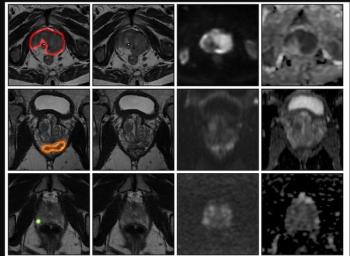
When the prostate-specific antigen (PSA) density was less than 0.15 ng/mL2, researchers noted a greater than 50 percent false positive rate in patients with zero or one PI-RADS 3-5 lesion, according to a new prostate magnetic resonance imaging (MRI) study involving over 2,500 patients.
For the retrospective study, recently published in Radiology: Imaging Cancer, researchers reviewed prostate multiparametric MRI (mpMRI) data from 2,548 men (mean age of 65.7) who had zero or one PI-RADS 3-5 lesion. False-positive (FP) results occurred in 831 cases (52 percent) and 150 patients (15.8 percent) had false-negative (FN) results, according to the study.
The researchers found that men with low PSA density were significantly less likely (a 55 percent odds ratio (OR) per 0.1 ng/mL2 increase in PSA density) to have FP results, Conversely, high PSA density was significantly associated with FN results with study authors noting a 2.05 OR per 0.1 ng/mL2 increase in PSA density. For patients with a PSA density > 0.45 ng/mL2, the researchers said the FN rate was approximately 60 percent.
“PSA density was the dominant predictor of FP and FN results and should be a major consideration when interpreting results of mpMRI (i.e, whether to biopsy an equivocal finding, or whether to re-biopsy if the first biopsy finding is negative),” wrote lead study author Bassel Salka, M.D., who is affiliated with the Department of Urology with the Henry Ford Health System in Detroit, and colleagues.