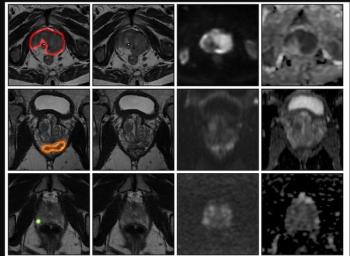
For biopsy-naïve men, the researchers emphasized the 96 percent negative predictive value (NPV) of pre-biopsy MRI in a cohort that had a 29 percent prevalence of csPCa.1
“These findings provide prospective evidence for the negative predictive value of MRI, surpassing the 90.8% reported in a recent systematic literature review,” added Hamm and colleagues.2
Three Key Takeaways
1. High negative predictive value. Pre-biopsy multiparametric MRI (mpMRI) demonstrated a 96 percent negative predictive value (NPV) for clinically significant prostate cancer (csPCa) in a biopsy-naïve cohort, significantly reducing unnecessary prostate biopsies.
2. Oncological safety. Negative pre-biopsy MRI findings allowed for safe clinical monitoring without an immediate biopsy in most cases with only a 4 percent prevalence of csPCa over three years in men with negative baseline MRI.
3. Cost-efficiency in monitoring. Clinical monitoring of patients with negative baseline MRI did not lead to significant increases in follow-up imaging or costs, demonstrating feasibility in community-based settings.
The researchers also noted a 32 percent cumulative incidence of follow-up MRI exams at three years for patients who had positive baseline MRI results in contrast to 15 percent for those with a negative baseline MRI and active monitoring. However, the prevalence of csPCa at three years was only slightly higher for those who had positive baseline MRI exams in comparison to men with a negative MRI (7 percent vs. 4 percent).
“ … Clinical monitoring did not lead to a great increase of follow-up imaging and, therefore, higher costs,” pointed out Hamm and colleagues.
(Editor’s note: For related content, see “Study Shows MRI-Targeted Biopsies Reduce Overdiagnosis of Clinically Insignificant PCa by 57 Percent,” “Can MRI-Based AI Bolster Biopsy Decision-Making in PI-RADS 3 Cases?” and “Emerging AI Platform Shows Promise for Prostate Cancer Detection on mpMRI.”)
In regard to study limitations, the authors cautioned against broad extrapolation of the study results, noting that the reviewed MRIs were drawn from two high-volume academic facilities and assessed by two expert radiologists. The researchers also pointed out that no AI diagnostic software was utilized and that recent advances in risk stratification, such as prostate-specific antigen calculation, were not incorporated into the current study.
References
1. Hamm CA, Asbach P, Pohlmann A, et al. Oncological safety of MRI-informed biopsy decision-making in men with suspected prostate cancer. JAMA Oncol. 2024 Dec 12. doi: 10.1001/jamaoncol.2024.5497. Online ahead of print.
2. Sathianathen NJ, Omer A, Harriss E, et al. Negative predictive value of multiparametric magnetic resonance imaging in the detection of clinically significant prostate cancer in the prostate imaging reporting and data system era: a systematic review and meta-analysis. Eur Urol. 2020;78(3):402-414.