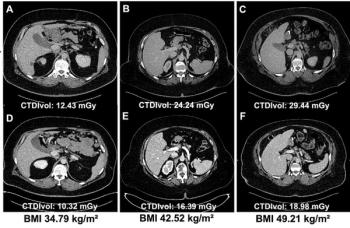
The study authors also pointed out a 55 percent reduction in the effective radiation dose with PCCT (3.49 mSv vs. 7.82 mSv) in comparison to EID CT along with 33 percent and 22 percent reductions in contrast agent injection rate (2 mL/sec vs. 3 mL/sec ) and volume (60.59 mL vs. 78.10 mL) respectively..
“PCCT images obtained with the quadruple-low scanning protocol exhibited higher objective and subjective image quality in both lung cancer lesions and lung parenchyma in three phases and increased the radiologist’s diagnostic confidence for all lung cancer imaging features, with reductions in radiation dose (55.37%) and contrast agent (22.42%) delivered to patients compared with those in energy-integrating detector CT using the conventional scanning protocol,” noted lead study author Xiaofei Yang, M.D., Ph.D., who is affiliated with the Department of Radiology at the First Affiliated Hospital of Zhengzhou University in Zhengzhou, China, and colleagues.
Three Key Takeaways
• Higher image quality with lower dose. A “quadruple-low” photon-counting CT (PCCT) protocol (reduced radiation dose, injection rate, contrast volume, and concentration) provided significantly higher SNR and CNR for lung lesions and parenchyma compared with conventional energy-integrating detector (EID) CT, improving both objective metrics and radiologist diagnostic confidence.
• Substantial radiation and contrast reduction: PCCT achieved a 55 percent reduction in effective radiation dose (3.49 mSv vs. 7.82 mSv), along with 33 percent lower injection rate and 22 percent lower contrast volume, supporting safer longitudinal imaging strategies in patients with lung cancer.
• Renal safety advantage. PCCT was associated with significantly less renal function change and eliminated contrast-induced nephropathy (0 percent vs. 7.9 percent with EID CT), suggesting particular benefit for patients with renal insufficiency undergoing serial follow-up imaging.
The study authors also noted significantly reduced renal function changes with PCCT and complete elimination of contrast-induced nephropathy (CIN) cases in comparison to a 7.9 percent rate of CIN with the use of EID CT.
“This suggests that PCCT with a quadruple-low strategy may be particularly beneficial for patients with renal insufficiency during follow-up examinations,” pointed out Yang and colleagues.
(Editor’s note: For related content, see “Study Shows Photon-Counting CT Reduces Radiation Exposure by 66 Percent for Patients with Lung Cancer,” “Photon-Counting CT Facilitates 87 Percent Reduction in Radiation Dosing for Emphysema Assessment” and “Computed Tomography: 2025 Year in Review.”)
Beyond the inherent limitations of a single-center retrospective study, the authors acknowledged that the findings, drawn from a Chinese cohort, may not be applicable to broader populations. The researchers also noted scanner-specific limitations that prevented matching use of reconstruction kernels and algorithms between PCCT and EID-CT obtained images.