








Catch up on the top radiology content of the past week.

Catch up on the top radiology content of the past week.

Indicated for the triage and notification of obstructive hydrocephalus on non-contrast brain computed tomography (CT), the artificial intelligence (AI)-enabled software is reportedly the first radiology triage modality to obtain the Food and Drug Administration’s (FDA) Breakthrough Device Designation.

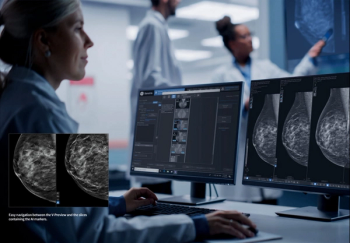
In a prospective study of over 55,000 women who had screening mammography, researchers found that double-reading by a radiologist and artificial intelligence (AI) was non-inferior to double-reading by two radiologists in detecting breast cancer.

Catch up on the top radiology content of the past week.

Through the use of artificial intelligence (AI) and imaging modalities such as ultrasound, CT, and MRI, the newly FDA-cleared VisAble.IO software reportedly enhances planning and real-time assessment for liver tumor ablation procedures.

In separate test sets that included challenging mammography cases, researchers found that artificial intelligence (AI) demonstrated similar sensitivity and specificity for detecting breast cancer in comparison to assessments from over 500 clinicians.

Catch up on the top radiology content of the past week.

In the third episode of a three-part podcast, Anand Narayan, M.D., Ph.D., and Amy Patel, M.D., discuss the challenges of expanded breast cancer screening amid a backdrop of radiologist shortages and ever-increasing volume on radiology worklists.

Catch up on the top five most viewed content at Diagnostic Imaging in August 2023.

The study demonstrated that the combined model yielded improved risk assessment for both interval and long-term breast cancers.

Catch up on the top AI-related news and research from the past month.

Catch up on the top radiology content of the past week.

In comparison to clinical-radiologic assessment, a deep learning CT radiomics nomogram had a 10 percent higher AUC and a 27 percent higher specificity for predicting the macrotrabecular massive subtype of hepatocellular carcinoma in external data testing.

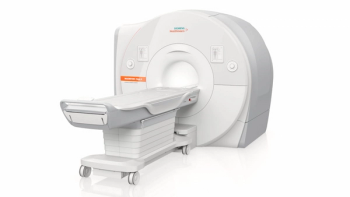
The Echelon Synergy MRI system reportedly uses deep learning technology to accelerate image acquisition and enhance image quality.

Catch up on the top radiology content of the past week.

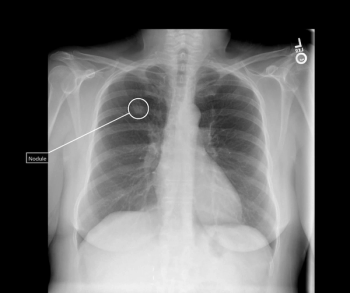
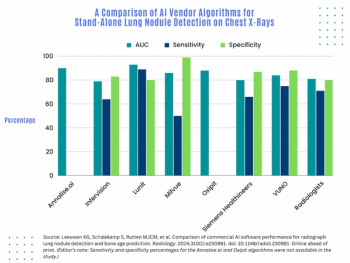
The artificial intelligence (AI)-enabled VisiRad XR reportedly demonstrated an 83 percent sensitivity rate for detecting lung nodules and masses on chest X-rays in one retrospective study.

The De Novo approval for Viz HCM, which assesses electrocardiograms with artificial intelligence (AI) to identify possible cases of hypertrophic cardiomyopathy (HCM), is the 12th FDA clearance of algorithms on the Viz.ai Platform.

Catch up on the top radiology content of the past week.

With reported performance validation on over 17,000 ultrasound images, Sonio Detect employs artificial intelligence (AI) to help ensure quality criteria for fetal ultrasound imaging of the brain and heart.

Reportedly the first randomized trial to examine the impact of artificial intelligence (AI) on screening mammography, researchers found AI-aided screening led to a 20 percent increase in breast cancer detection and a 44.3 percent decrease in mammography screening workload.

Catch up on the top AI-related news and research from the past month.

Through automated processing of diffusion-weighted magnetic resonance imaging (MRI) scans, the Advanced Neuro Diagnostic Imaging (ANDI) software performs detailed analysis of white matter microstructure.

Catch up on the top radiology news of the past week.

In a study of over 1.300 women with dense breasts, the combination of mammography and ultrasound had a recall rate of 11.7 percent, a specificity rate of 89.1 percent and an accuracy rate of 89.2 percent in comparison to a 21.4 percent recall rate, 79.4 percent specificity and 79.5 percent accuracy for the combination of mammography, ultrasound, and artificial intelligence (AI).

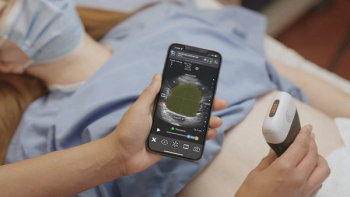
Indicated for use in two-dimensional transthoracic echocardiography (2D-TTE) in adults, the AI Guidance software reportedly enables novice ultrasound users to obtain real-time cardiac imaging at the point of care.