
Commentary|Videos|July 15, 2026
Breast Imaging in Focus: Can Automated Breast Ultrasound Have an Impact in Screening for Women with Dense Breasts?
Author(s)Manisha Bahl, MD
In the latest episode of her “Breast Imaging in Focus” series, Manisha Bahl, MD, MPH, FSBI, discusses new research examining the utility of automated breast ultrasound in supplemental screening for women with dense breasts.
Advertisement
For women with dense breast tissue, supplemental ultrasound remains the most widely available screening option beyond mammography. However, handheld ultrasound is operator-dependent and can be time consuming to perform.
Automated breast ultrasound (ABUS) was developed to address these limitations through more standardized image acquisition. A recent article, therefore, addressed an important clinical question: Does ABUS perform as well as handheld ultrasound for supplemental screening in real-world clinical practice?
To answer this question, investigators analyzed data from the Breast Cancer Surveillance Consortium (BCSC). The study included more than 25,000 supplemental screening ultrasound exams, including approximately 4,200 automated breast ultrasound exams and approximately 21,000 handheld ultrasound exams. The exams were performed in women aged 40 to 74 years with heterogeneously dense or extremely dense breast tissue and no personal history of breast cancer across 27 United States imaging facilities between 2017 and 2020.1
Let's begin with the most important question: Did ABUS detect as many cancers as handheld ultrasound? The answer is yes. The cancer detection rate was 2.5 cancers per 1,000 screening exams with ABUS compared with 1.7 cancers per 1,000 exams with handheld ultrasound.1 This difference was not statistically significant. Positive predictive values for biopsy were also similar between the two techniques, suggesting that ABUS maintains comparable cancer detection performance.
After adjustment for patient and facility characteristics, the abnormal interpretation rate or recall rate was lower for ABUS (15 percent compared with 19 percent). Even more striking was the difference in short interval follow-up recommendations. Only 3 percent of women undergoing ABUS ultimately received a BI-RADS 3 recommendation, compared with nearly 15 percent of women undergoing handheld ultrasound.1
Interestingly, biopsy recommendation rates were essentially identical between the two modalities as were false positive biopsy recommendation rates. In other words, ABIS resulted in fewer recalls and fewer six-month follow-up recommendations without reducing cancer detection or increasing unnecessary biopsies. Of note, ABUS actually generated more initial BI-RADS-0 assessments than handheld ultrasound. Many of these patients returned for targeted diagnostic ultrasound, at which time the question findings were resolved as benign. As a result, fewer women ultimately received a BIRADS 3 assessment requiring six-month follow-up.
As with any observational study, several limitations should be considered. This study was not a randomized trial, introducing the possibility of selection bias. Although the investigators adjusted for breast cancer risk and numerous patient and facility level factors, residual confounding cannot be excluded.
In addition, the study did not evaluate radiologist experience with ABUS because interpretation of ABUS requires dedicated training and familiarity with its imaging appearance. Reader experience may have influenced performance.
This study is important for several reasons. First, it provides reassuring evidence that practices using ABUS are not sacrificing cancer detection compared with traditional handheld ultrasound. Second, reducing recalls and especially reducing unnecessary BI-RADS 3 recommendations has meaningful benefits for patients, including fewer additional appointments. Finally, this study reflects real-world practice across 27 imaging facilities, making the findings especially relevant to everyday practice.
This study suggests that ABUS performs at least as well as handheld ultrasound for supplemental screening in women with dense breast tissue. Cancer detection was comparable between the two techniques, but ABUS was associated with a lower recall rate and fewer short interval follow-up recommendations. While randomized trials would provide stronger evidence, this large real-world study supports ABUS as an effective alternative to handheld ultrasound for women with dense breast tissue.
Dr. Bahl is an associate professor at Harvard Medical School and a breast radiologist affiliated with Massachusetts General Hospital.
Reference
- Rauscher GH, Alsheik N, Eavey J, et al. Comparison of supplemental breast cancer screening outcomes for automated versus hand-held ultrasound. J Am Coll Radiol. 2026 July 3. Available at:
https://www.jacr.org/article/S1546-1440(26)00336-4/fulltext .
Advertisement
Related to this article
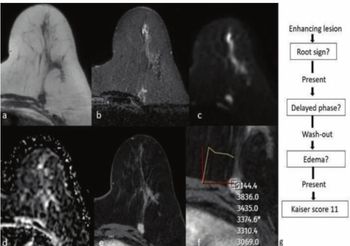
A Kaiser score > 5 with breast MRI demonstrated a 97 percent sensitivity and 87.9 percent specificity for predicting malignancy in patients with BI-RADS 0 or 4 presentations on mammography and breast ultrasound, according to a new study.
In the second of a three-part podcast episode, Wendie Berg, MD, PhD, FACR, FSBI, Manisha Bahl, MD, and Amy Patel, MD discuss how to handle disagreements with adjunctive AI in breast imaging, whether to include AI assessments in PACS, and whether patients should pay for the use of adjunctive AI.

Catch up on the top radiology content of the past week.
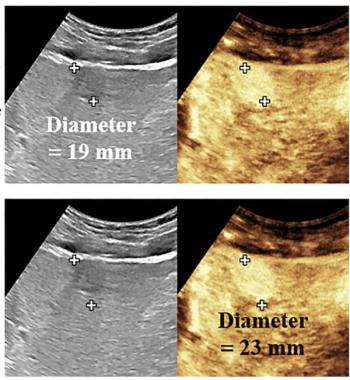
For patients with hepatocellular carcinoma (HCC), perfusion beyond tumor margin on contrast-enhanced ultrasound that exceeds gray-scale ultrasound tumor measurement by 5 mm is associated with a 76 percent higher risk of worse recurrence-free survival, according to newly published research.
Catch up on the top radiology content of the past week.
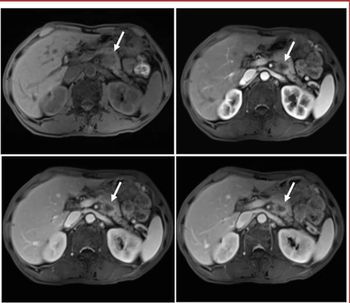
Magnetic resonance imaging offered a 29 percent higher sensitivity than CT for differentiating liver metastases, but CT provided 12 percent higher sensitivity than MRI for assessing vascular invasion, according to a new 40-study meta-analysis.

Facilitating enhanced 3D visualization of skeletal anatomy, the BoneEnhance machine learning module reportedly provides automated segmentation of bone and surrounding tissues for the Accuro XV ultrasound system.

In the latest episode of her Breast Imaging in Focus series, Manisha Bahl, MD, MPH, FSBI, discusses new research comparing mammography-based AI models for breast cancer detection and short-term risk prediction.
Advertisement
Advertisement
Trending on Diagnostic Imaging
1
FDA Clears Machine Learning Module for Emerging Musculoskeletal Ultrasound Platform
2
Could Photon-Counting CT Have an Impact as a Platform for Molecular Imaging?
3
What’s Next for AI in Radiology?: Facilitating Data Orchestration Over Fragmentation
4
Can MRI-Based AI Have an Impact in Reducing Unnecessary Prostate Biopsies?
5