
Commentary|Videos|May 14, 2026
Breast Imaging in Focus: What New Multicenter Research Reveals About Breast Arterial Calcification on Mammography
Author(s)Manisha Bahl, MD
In the latest episode of her “Breast Imaging in Focus” series, Manisha Bahl, MD, MPH, FSBI, discusses a new study of breast arterial calcification on mammography and practical clinical implications for breast radiologists.
Advertisement
Breast arterial calcification (BAC) has traditionally been viewed as an incidental finding on mammography.However, this perception is changing rapidly. BAC is a form of medial arterial calcification visible on mammography and growing evidence demonstrates that BAC is associated with cardiovascular disease, including ischemic heart disease, stroke, heart failure and mortality.
This clinical development is particularly important because Maryland recently become the first state to pass legislation requiring patient notification when BAC is identified on mammography. This law will take effect on October 1, 2026.
A recent article published in
The authors performed a multicenter retrospective cohort study of 21,514 women aged 40 years or older, without known cardiovascular disease, who underwent screening mammography and atherosclerotic cardiovascular disease (ASCVD) risk assessment.1 Breast arterial calcification was quantified using an AI based tool and expressed as an age-adjusted percentile. The primary outcome was major adverse cardiovascular events (MACE), including death, ischemic heart disease, stroke and heart failure. The age adjustment is important because BAC increases with age. As a result, the same raw BAC score may have very different clinical significance in a 45-year-old woman compared with a 75-year-old woman.
The authors therefore developed an age-adjusted BAC percentile nomogram analogous to age-based coronary artery policy and percentiles used in cardiovascular imaging.
For radiologists, this approach may eventually make BAC reporting more clinically meaningful and easier to communicate to referring physicians and patients.
Breast arterial calcification was identified in 22.7 percent of women and increased with age from 8 percent in women younger than 50 years to 61 percent in women older than 70 years. During a mean follow-up period of 4.7 years, 828 major adverse cardiovascular events occurred. Each 10 percentile increase in BAC was associated with increased risk of MACE independent of conventional cardiovascular risk factors.1
Importantly, the addition of BAC to a conventional risk assessment model improved cardiovascular risk prediction. The C statistic increased from .67 to .71 and BAC improved risk reclassification, particularly among women categorized as low or intermediate risk by conventional risk assessment models.1
For breast imaging radiologists, the clinical implications of these findings are practical.
• Breast arterial calcification should no longer be regarded as merely an incidental mammography finding.
• Automated BAC quantification may help reduce workflow burden and facilitate standardized reporting practices.
• BAC reporting may become increasingly relevant as legislation and patient notification requirements expand beyond Maryland.
At the same time, careful communication remains important. The authors emphasize that formal guideline directed management thresholds for BAC have not yet been established for radiologists, and especially breast imaging radiologists, the challenge moving forward will be to report BAC in a manner that is standardized, clinically responsible and useful for downstream cardiovascular risk assessment.
Dr. Bahl is an associate professor at Harvard Medical School and a breast radiologist affiliated with Massachusetts General Hospital.
Reference
- Nerlekar N, Soh CH, Vasanthakumar S, et al. A novel breast arterial calcification age-based percentile nomogram for the incremental prediction of incidental cardiovascular events. JACC Cardiovasc Imaging. 2026 Apr 24:S1936-878X(26)00152-X. doi: 10.1016/j.jcmg.2026.03.008. Online ahead of print.
Advertisement
Related to this article

In the latest episode of her Breast Imaging in Focus series, Manisha Bahl, MD, MPH, FSBI, discusses new research comparing mammography-based AI models for breast cancer detection and short-term risk prediction.
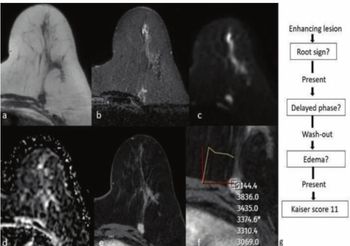
A Kaiser score > 5 with breast MRI demonstrated a 97 percent sensitivity and 87.9 percent specificity for predicting malignancy in patients with BI-RADS 0 or 4 presentations on mammography and breast ultrasound, according to a new study.

In the third of a three-part podcast episode, Wendie Berg, MD, PhD, FACR, FSBI, Manisha Bahl, MD, and Amy Patel, MD discuss recent developments with autonomous AI in breast imaging and share their perspective on the overall potential of AI to help mitigate the radiologist shortage.
In the second of a three-part podcast episode, Wendie Berg, MD, PhD, FACR, FSBI, Manisha Bahl, MD, and Amy Patel, MD discuss how to handle disagreements with adjunctive AI in breast imaging, whether to include AI assessments in PACS, and whether patients should pay for the use of adjunctive AI.
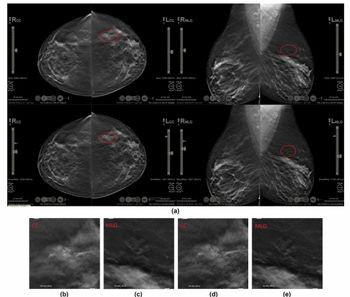
Use of the AI-enabled slab technology from reconstructed DBT imaging led to a 7.4-second mean reduction in reading time in a new study involving 391 cases and 15 reviewing radiologists.

Facilitating enhanced 3D visualization of skeletal anatomy, the BoneEnhance machine learning module reportedly provides automated segmentation of bone and surrounding tissues for the Accuro XV ultrasound system.
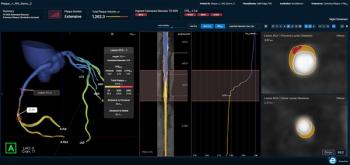
The FFR-IQ software recently demonstrated a 92.2 percent sensitivity for non-invasive estimation of fractional flow reserve (FFRC) based on coronary CT angiography (CCTA) scans.

In a recent interview, Francesco Giganti, MD, PhD, discussed findings from a recent multicenter study demonstrating the ability of an AI software to provide significant clarity to initial PI-RADS 3 assessments on MRI and facilitate a nearly 19 percent reduction in unnecessary prostate biopsies.
Advertisement
Advertisement
Trending on Diagnostic Imaging
1
What’s Next for AI in Radiology?: Facilitating Data Orchestration Over Fragmentation
2
Distraction-Free Discipline for Staying in the Zone in Radiology
3
Study Shows PCCT Offers Higher Image Quality and Reduced Radiation Dosing than EID-CT in Obese Patients
4
FDA Clears Machine Learning Module for Emerging Musculoskeletal Ultrasound Platform
5