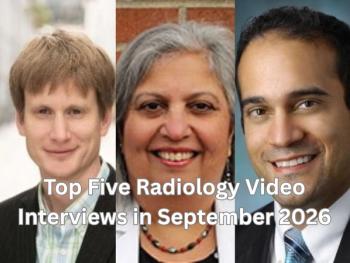
Catch up on the most well-viewed video interviews from Diagnostic Imaging in September 2026.
Catch up on the top radiology content of the past week.
Welcome to Diagnostic Imaging’s Weekly Scan, which offers an opportunity to catch up on the most well-viewed radiology content of the past week.
A large multicenter retrospective cohort study published in Radiology has found that
In a recent interview with Diagnostic Imaging, lead study author Connie Lehman, MD, PhD, discussed the potential of this dynamic risk-adaptive screening.
In a new study looking at
In a recent interview discussing the SNMMI conference,
In a recent episode of our “Molecular Imaging in Focus” series, Surekha Yadav, MBBS, MD, discussed research presented at the SNMMI conference that showed
The Food and Drug Administration (FDA) has granted 510(k) clearance for the VascularAssist Occlusion Triage (VAOT) software,
Thank you for checking out the latest edition of Diagnostic Imaging’s Weekly Scan.