The cellularity factor with time-dependent diffusion MRI also accounted for the highest AUC for predicting pCR to neoadjuvant chemotherapy in women with triple-negative breast cancer (TNBC) (92 percent), women with the luminal B subtype of breast cancer (78 percent) and those with the HER2-enriched subtype (74 percent).
“Cellularity was a crucial marker among time-dependent diffusion MRI microstructural parameters and showed the highest performance in predicting pCR,” wrote lead study author Xiaoxia Wang, M.D., who is affiliated with the Department of Radiology at the Chongqing University Cancer Hospital and the Chongqing Key Laboratory for Intelligent Oncology in Breast Cancer in Chongqing, China, and colleagues.
Three Key Takeaways
1. Predictive power of time-dependent diffusion MRI. Time-dependent diffusion MRI, particularly the cellularity parameter, showed the highest predictive accuracy (84 percent AUC) for determining the pathologic complete response (pCR) to neoadjuvant chemotherapy, outperforming standard ADC measurements and clinical-pathologic models.
2. Performance in subtypes. The cellularity parameter demonstrated high predictive accuracy for pCR across various breast cancer subtypes, achieving 92 percent AUC for triple-negative breast cancer (TNBC), 78 percent for luminal B, and 74 percent for HER2-enriched subtypes.
3. Subtype Identification. Time-dependent diffusion MRI microstructural mapping was more effective in identifying molecular subtypes of breast cancer (70-85 percent AUC range) than conventional methods like intravoxel incoherent motion or diffusion-kurtosis imaging, making it a valuable tool for subtype characterization.
The researchers also determined that time-dependent diffusion MRI microstructural mapping had a higher AUC range overall for determining molecular subtypes of breast cancer (70 to 85 percent) in contrast to that of intravoxel incoherent motion (60 percent to 86 percent) and diffusion-kurtosis imaging (50 percent to 78 percent) obtained with DWI MRI.
“In our study, time-dependent diffusion MRI microstructural parameters demonstrated excellent performance in helping to identify four molecular subtypes … , which was better than that of the apparent diffusion coefficient parameters derived from diffusion-weighted imaging,” noted Wang and colleagues.
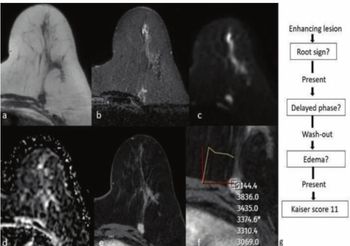
(Editor’s note: For related content, see “Can DWI MRI Offer a Viable Non-Contrast Alternative for Breast Cancer Assessment?,” “Enhancing Lesions on Breast MRI: Can an Updated Kaiser Scoring Model Improve Detection?” and “Breast MRI Study Examines Common Factors with False Negatives and False Positives.”)
Beyond the inherent limitations of a single-center exploratory study, the authors acknowledged manual definition of tumor regions of interest. They also conceded that the use of average time-dependent diffusion MRI microstructure parameters for tumor regions of interest did not take intratumoral heterogeneity into account. The study authors also pointed out that the potential for variability between pulsed gradient spin echo and oscillating gradient spin echo MRI sequences due to intravoxel incoherent motion effects.