Interventional Radiology in Focus: Examining the Potential of AI for IR Applications and Facilitating Improved Outcomes
In the latest episode of his “Interventional Radiology in Focus” series, Mina Makary, MD, discusses current and potential pre-procedure, intra-procedure and post-procedure applications of AI for interventional radiology.
AI is a very exciting opportunity for us in interventional radiology (IR). I think there are a lot of opportunities to use AI in the different phases of IR care, whether it's before the procedure, during the procedure, or after the procedure.
In terms of the pre-procedural phase of care, AI tools can help with information gathering. For example, they can help us create a summary of relevant patient records that are pertinent to the treatments that we deliver to the patient. AI can help us to triage patients, whether it's in terms of urgency or clinical factors that are taken into consideration that help us appropriately deliver our resources in an evidence-based fashion for our patients.
There are numerous clinical decision support tools that are being developed or are already developed. One of the most exciting aspects of that is how can we use AI to help predict treatment outcomes based on clinical and demographic factors. I think that's a big promise, and it can also help us with patient selection and risk stratification based on that particular patient profile and input data. These are areas that we can leverage the technology for in the pre-procedural space.
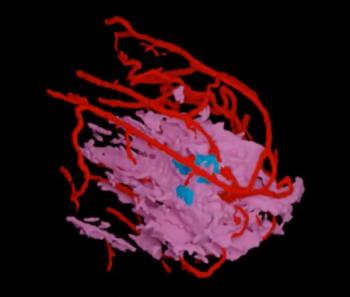
There are also applications in the pre-procedural planning process in the form of AI-based augmented reality and virtual reality tools that help us conceptualize complex anatomy and help determine our approach to the treatment. There are other tools that can simulate environments and advanced renderings that not only help us in interventional radiology but help us communicate complex information with surgeons and referring physicians. There are platforms that would help us practice and improve technical skills. This can be particularly beneficial for trainees, residents and students so they can use AI to train and plan for procedures without patient risk. That is another way we can leverage the technology to improve the pre-procedural space.
There may also be intra-procedure applications. For example, intra-procedural AI tools may help us segment or visualize the target lesions better in the procedure, Can AI help us with device selection? Can AI evaluate an angiogram and, as we work together through the case, make a recommendation? What's the proper stent size? What's the proper balloon? What's the proper agent to address a lesion? Can it also predict how we navigate vessels and help us with our catheter choices? There are a lot of opportunities to optimize that intra-procedural space.
Last, but not least, are post-procedural applications. When I think about AI in that space, I'm thinking about tools that help us reduce length of stay or admission requirements. Can AI help me in predicting which patients, based on their risk factors, would need the extended stay in the hospital or a different level of care? Can AI tools help us optimize our imaging algorithms to evaluate treatment response and maybe predict different outcomes sooner?
In addition to clinical applications, can AI help us with documentation tools and procedure dictations? This is a big area for text-based tools, especially with large language models that we have. Can AI help us develop real-time chatbots for common patient concerns? For common queries, can AI help patients get answers quickly and effectively? Could AI provide administrative assistance for scheduling care and follow-ups?
With any opportunity, there are also challenges and limitations we have to think about for AI. We have to ensure these algorithms are trained on good, high-quality data. The other thing is a lot of our procedures may have lack of standardization. There are different techniques, different precision preferences and different tools. All of that will come into play as we develop these tools along with variations in patient anatomy and pathology. What level of accuracy or risk or error are we willing to take? There are also adoption challenges in terms of costs. Like any new technology, it will require a certain level of investment. What about liability questions/ If an algorithm makes a mistake, who's liable: the physician, the hospital system, the owner or the software developer? All those questions need to be answered.
How do we integrate those systems with our existing systems, talking to the electronic medical record or PACS to allow for seamless integration and interchange of data? We also need to consider cybersecurity so we can protect patient privacy.
One of the biggest joys of my job is the doctor-patient relationship. We're doctors first. We're everything else second. How are these computer-based software and systems going to be integrated in that environment? Are they going to disrupt that patient-doctor relationship? Is everything going to be an algorithm and a computer response, and we're going to lose that human touch? That is something twe have to preserve as we uphold our specialty and integrate these tools successfully in our practice.
Dr. Makary is a vascular and interventional radiologist. He is an associate professor of radiology at the Ohio State University Wexner Medical Center.
Related to this article