What New Breast MRI Research Reveals
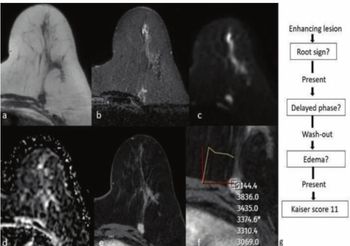
In contrast to a 2025 meta-analysis finding greater than 10 percent reductions in sensitivity and specificity with moderate or marked background parenchymal enhancement (BPE) on breast MRI, new research published in European Radiology suggested the BPE has no impact on cancer detection with breast MRI.12,13
In the retrospective study involving 282 breast lesions with biopsy results, researchers found no statistically significant differences in AUC, sensitivity nor specificity for breast cancer detection between women who had minimum/mild BPE and those who had moderate/marked BPE.13
A study published in Academic Radiology evaluated pre- and post-NAC cardiac and brain MRI parameters in 85 breast cancer patients — 18 with cancer therapy-related cardiac dysfunction (CTRCD) and 67 without — and assessed the relationship to cognitive function. The findings suggested that NAC-associated cardiotoxicity and neurotoxicity may be interrelated rather than independent processes, supporting an integrated approach to monitoring in this patient population.14,15
Social Risk Factors and Breast Cancer Screening Equity
Research presented at the SBI Symposium examined the relationship between social risk factors and completion of follow-up diagnostic imaging after an abnormal screening mammogram.16,17 This work adds to a growing body of evidence indicating that social determinants of health — including food insecurity, transportation barriers, and housing instability — are associated with reduced mammography utilization and delayed diagnostic follow-up, with implications for early breast cancer detection across populations.
Can A Breast Radiologist Become U.S. Surgeon General?
On April 30, 2026, President Trump nominated Nicole Saphier, MD, a breast radiologist and associate professor of radiology at Weill Cornell Medical College and Memorial Sloan Kettering Cancer Center (MSKCC), to serve as U.S. Surgeon General.18,19 Amy Patel, MD, said Dr. Saphier is “a fierce advocate for patient care and access” and a “hard-working steward” for radiology.19
References
1. Elias-Cabot E, Romero-Martin S, Raya-Povedano JL, Rodriguez-Ruiz A, Alvarez-Benito M. AI-based triage and decision support in mammography and digital tomosynthesis for breast cancer screening: a paired, noninferiority trial. Nat Med. 2026 Mar 19. doi: 10.1038/s41591-026-04277-x. Online ahead of print.
2. Bahl M. Breast Imaging in Focus: Can partially autonomous AI-supported screening have an impact with mammography and DBT? Diagnostic Imaging. Available at: https://www.diagnosticimaging.com/view/breast-imaging-focus-partially-autonomous-ai-supported-screening-mammography-dbt- . Published April 13, 2026. Accessed April 30, 2026.
3. Lamb LR. Artificial intelligence for earlier detection of breast cancer on screening digital breast tomosynthesis. Presented at the Society of Breast Imaging Symposium, April 16-19, 2026, Seattle. https://2026-sbi-symposium.eventscribe.net/
4. Can AI detect breast cancer on DBT years earlier than radiologists? Diagnostic Imaging. Available at: https://www.diagnosticimaging.com/view/can-ai-detect-breast-cancer-dbt-years-earlier-than-radiologists- . Published April 24, 2026. Accessed April 30, 2026.
5. FDA clears updated version of 3D mammography algorithm from Lunit. Diagnostic Imaging. Available at: https://www.diagnosticimaging.com/view/fda-clears-updated-version-3d-mammography-algorithm-lunit . Published April 18, 2026. Accessed April 30, 2026.
6. Lunit. Lunit surpasses 330+ sites and 1M annual screenings as breast imaging AI moves into clinical practice. April 16, 2026. Available at: https://www.prnewswire.com/news-releases/lunit-surpasses-330-sites-and-1m-annual-screenings-as-breast-imaging-ai-moves-into-clinical-practice-302744532.html . Published April 16, 2026. Accessed April 30, 2026.
7. National Comprehensive Cancer Network. NCCN Clinical Practice Guidelines in Oncology (NCCN Guidelines). Breast Cancer Screening and Diagnosis. Version 2.2025—March 28, 2025. Available at: https://www.nccn.org/professionals/physician_gls/pdf/breast-screening.pdf . Accessed April 30, 2026.
8. Hall J. A closer look at the latest updates to the NCCN guidelines on breast cancer screening. Diagnostic Imaging. Available at: https://www.diagnosticimaging.com/view/closer-look-latest-updates-nccn-guidelines-breast-cancer-screening . Published April 16, 2026. Accessed April 30, 2026.
9. Qaseem A, Harrod CS, Balk EM, et al. Screening for breast cancer in asymptomatic, average-risk adult females: a guidance statement from the American College of Physicians (version 2). Ann Intern Med. 2026 Apr 17. doi: 10.7326/ANNALS-25-05116. Online ahead of print.
10. American College of Radiology and Society of Breast Imaging. New ACP Breast Cancer Screening Guidelines Are a Step Backward that May Cost Lives. PRNewswire. April 17, 2026. Available at: https://www.prnewswire.com/news-releases/new-acp-breast-cancer-screening-guidelines-are-a-step-backward-that-may-cost-lives-302746220.html . Published April 17, 2026. Accessed April 30, 2026.
11. Hall J. Breast radiologists say new ACP breast cancer screening guidelines are 'many steps backward' and 'dangerous.' Diagnostic Imaging. Available at: https://www.diagnosticimaging.com/view/breast-radiologists-new-acp-breast-cancer-screening-guidelines-many-steps-backward-dangerous- . Published April 27, 2026. Accessed April 30, 2026.
12. Bechyna S, Baltzer PAT. Impact of background parenchymal enhancement on diagnostic performance of breast MRI: a systematic review and meta-analysis. Radiology. 2025;315(2):e241919. doi: 10.1148/radiol.241919.
13. Hall J. New breast MRI study says background parenchymal enhancement has no impact on lesion detection. Diagnostic Imaging. Available at: https://www.diagnosticimaging.com/view/breast-mri-study-background-parenchymal-enhancement-no-impact-lesion-detection . Published April 6, 2026. Accessed April 30, 2026.
14. Luo X, Liu D, Tan Y. MRI characteristics of cardiotoxicity and neurotoxicity in patients with breast cancer treated with neoadjuvant chemotherapy: dynamic changes and interrelationships. Acad Radiol. 2026 Apr 7:S1076-6332(26)00190-X. doi: 10.1016/j.acra.2026.03.024. Online ahead of print.
15. Hall J. MRI study reveals potentially severe impact of NAC on heart and brain function in breast cancer patients. Diagnostic Imaging. 2026. Available at: https://www.diagnosticimaging.com/view/mri-study-potentially-severe-impact-nac-heart-brain-function-breast-cancer-patients . Published April 7, 2026. Accessed April 30, 2026.
16. Miles BL. Social risk and completion of diagnostic workup after abnormal screening mammography: a global, multicenter cohort. Presented at the Society of Breast Imaging (SBI) Symposium, April 16-19, 2026, Seattle. Available at: https://2026-sbi-symposium.eventscribe.net/ .
17. Hall J. SBI: What a new study reveals about social risk factors and follow-up imaging after abnormal screening mammograms. Diagnostic Imaging. 2026. Available at: https://www.diagnosticimaging.com/view/sbi-new-study-social-risk-factors-follow-up-imaging-abnormal-screening-mammograms . Published April 17, 2026. Accessed April 30, 2026.
18. Trump nominates breast radiologist Nicole Saphier as Surgeon General. The Hill. Available at: https://thehill.com/policy/healthcare/5857814-nicole-saphier-surgeon-general-nominee/ . Published April 30, 2026. Accessed April 30, 2026.
19. Hall J. Breast radiologist nominated for Surgeon General by President Trump. Diagnostic Imaging. 2026. Available at: https://www.diagnosticimaging.com/view/breast-radiologist-nominated-surgeon-general-president-trump . Published April 30, 2026. Accessed April 30, 2026.