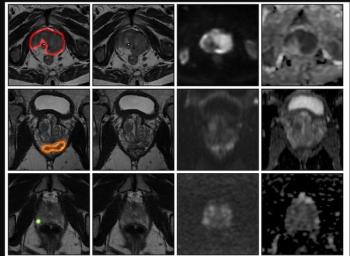
Noting that 18F-labeled radiotracers have lower positron energy, which facilitates better spatial resolution, the meta-analysis authors also pointed out that the metabolic pathway of 18F-PSMA-1007 may offer unique advantages in comparison to other PET/CT radiotracers.
“ … 18F-PSMA-1007 shows significantly reduced activity in (the) bladder, Besides, its hepatic-biliary excretion pathway can facilitate the detection of local tumor recurrence and pelvic lymph node metastases, which enables accurate identification of tumors near physiological urine uptake sites,” wrote lead study author Yiming Chen, M.D., who is affiliated with the Department of Radiology at the First Hospital of China Medical University in Shenyang, China, and colleagues.
The researchers noted that the aforementioned PET/CT radiotracers as well as the 68Ga-PSMA-617 PET/CT radiotracer had 15 percent or greater SUCRA than mpMRI (52.3 SUCRA) at the patient level in the detection of csPCa. They also found that these four PET/CT radiotracers and the PET/CT agent 68Ga-RM2 offered significantly higher lesion-level detection of csPCa than mpMRI.
Three Key Takeaways
1. Superior diagnostic performance. Among the nine PET/CT radiotracers evaluated, 18F-PSMA-1007 demonstrated the highest SUCRA for detecting clinically significant prostate cancer (csPCa) at both patient and lesion levels, outperforming other commonly used tracers such as 68Ga-PSMA-11 and 18F-DCFPyL.
2. Improved spatial resolution and detection. The lower positron energy of 18F-labeled radiotracers provides better spatial resolution. Additionally, 18F-PSMA-1007’s hepatic-biliary excretion pathway minimizes bladder activity, improving lesion detection, especially in cases of local recurrence and pelvic lymph node metastases.
3. PET/CT superiority over mpMRI. Several PET/CT radiotracers, including 18F-PSMA-1007, 68Ga-PSMA-11, 18F-DCFPyL, and 68Ga-PSMA-617, outperformed multiparametric MRI (mpMRI) in detecting csPCa, suggesting that PET/CT may be a more reliable imaging modality for high-risk patients.
The meta-analysis authors found that 68Ga-PSMA-11 had the highest usage frequency of the reviewed PET/CT radiotracers. They also noted research that has shown the favorable diagnostic efficacy of 68Ga-PSMA-11 for biomechanical recurrence and metastatic disease as well as one study’s finding of 100 percent specificity for high-risk PCa.
“Based on these conclusions, we believed that 68Ga-PSMA-11 is a broadly applicable and promising radiotracer,” posited Chen and colleagues.
(Editor’s note: For related content, see “Can AI Enhance PET/MRI Assessment for Extraprostatic Tumor Extension in Patients with PCa?,” “Study Shows Discordance Between PSMA PET/CT and PSA Response in 47 Percent of Patients Treated for mCRPC” and “Can 18F-Flotufolastat Bolster Detection of PCa Recurrence in Patients with Low PSA Levels After Radical Prostatectomy?”)
In regard to limitations with the meta-analysis, the authors acknowledged small sample sizes with some of the reviewed studies, incomplete information on patient covariates that precluded meta-regression analysis, and variations in methodology and patient cohorts that prevented subgroup analysis.