

News|Videos|October 20, 2026
Can MRI-Based AI Have an Impact in Reducing Unnecessary Prostate Biopsies?
Author(s)Jeff Hall
In a recent interview, Francesco Giganti, MD, PhD, discussed findings from a recent multicenter study demonstrating the ability of an AI software to provide significant clarity to initial PI-RADS 3 assessments on MRI and facilitate a nearly 19 percent reduction in unnecessary prostate biopsies.
Advertisement
Emerging research from a recently published study suggest that artificial intelligence (AI) can provide significant benefit in reducing uncertainty with initial PI-RADS 3 evaluations on prostate MRI.
For the retrospective multicenter study, recently published in
Does AI Enhance Biopsy Triaging with Prostate MRI?
The researchers found that the AI software led to upgraded assessments in 93.1 percent of prostate lesions csPCa-positive lesions originally deemed as PI-RADS 3 presentations and noted low risk for 24.1 percent of lesions garnering initial PI-RADS 3 classification. The AI software combined a 98.4 percent sensitivity with an 18.9 percent reduction in unnecessary prostate biopsies, according to the study authors.
In a recent interview with Diagnostic Imaging, Francesco Giganti, MD, PhD, a co-author of the study, shared his perspective on the key findings.
“I definitely think that biopsy triaging is maybe the clearest opportunity for AI to have a role in prostate MRI at the moment. If we, for example, add the risk information that we get from the three-point scale that we have just published, this can help … the radiologist in determining if the lesion has to be biopsied or not,” maintained Dr. Giganti, a professor of radiology at University College London.
How Does AI Stack Up with Lesion-Level Sensitivity for Prostate MRI?
However, while the study revealed that the sensitivity of the AI software was non-inferior to the PI-RADS classification system (97.6 percent vs. 92.6 percent), the researchers also noted 10 percent lower sensitivity for AI at the lesion level (78.8 percent vs. 88.8 percent).
“This means that basically, it's not picking up all the cancers within the prostate, which is something that we have seen in the AI literature,” added Dr. Giganti. “ … I think the clinical message that we tried to convey with this study is that AI is supporting the radiologist. The clinical message for us is to combine AI, the information that we can get with this three-point scale, with the interpretation from experts. Radiologists are, in the end, responsible for lesion mapping, but (it can be done) with the aid of AI.”
Advertisement
Related to this article
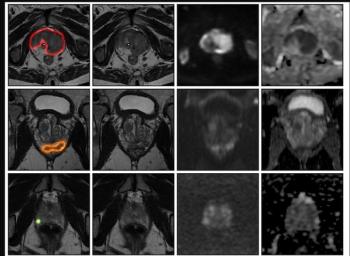
An AI model for prostate MRI offered an 89 percent AUC for prostate cancer detection in external validation testing, according to a newly published international multicenter study.
In the second of a three-part podcast episode, Wendie Berg, MD, PhD, FACR, FSBI, Manisha Bahl, MD, and Amy Patel, MD discuss how to handle disagreements with adjunctive AI in breast imaging, whether to include AI assessments in PACS, and whether patients should pay for the use of adjunctive AI.
Catch up on the top radiology content of the past week.
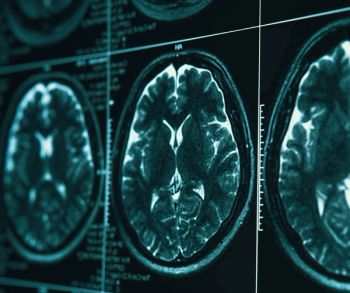
The NEXT-Cue AI software, which incorporates analysis of brain MRI scans, reportedly facilitates prognostic assessments of potential progression from mild cognitive impairment (MCI) to Alzheimer’s disease within five years.
Catch up on the top radiology content of the past week.
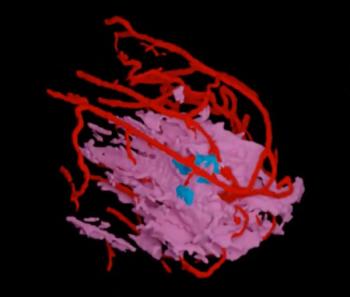
Assessing breast MRI scans, pathology and clinical data, the AI-powered TumorSight Risk software reportedly provides five- and 10-year risk for breast cancer recurrence for women with HR+, HER2-negative stage I-IIIA breast cancer.
Catch up on the top radiology content of the past week.
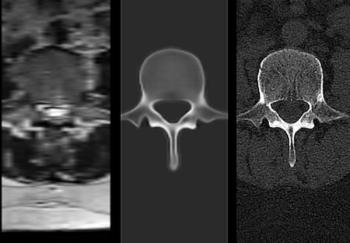
The cloud-based NextMR platform reportedly provides automated 3D bone images of conventional spine MRI images in less than 60 seconds.
Advertisement
Advertisement
Trending on Diagnostic Imaging
1
The Reading Room Podcast: A Closer Look at New Research on 177Lu-Edotreotide for Treating GEP-NETs
2
FDA Clears MRI-Based AI Software for Prognostic Evaluation of Patients with Mild Cognitive Impairment
3
How AI, Theranostics and More Empowered Patients Have Led to Significant Changes in Radiology
4
See the Real-World Impact of AI in Radiology
5