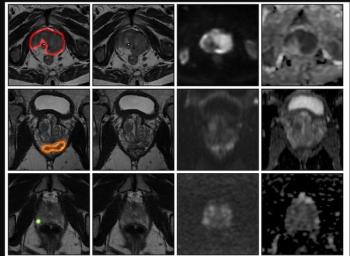
The researchers also noted similar detection rates between abbreviated bpMRI and mpMRI for clinically insignificant PCa (9.2 percent vs. 9.6 percent).
“The PRIME study demonstrates that a shorter and less resource-intensive biparametric MRI detects as much clinically significant cancer as the full multiparametric MRI, without increasing the diagnosis of clinically insignificant cancer. Despite earlier concerns that lack of contrast information would lead to more biopsy recommendations, this study found no evidence of this, with biopsy rates being very similar between biparametric MRI and multiparametric MRI,” noted lead study author Alexander Ng, MBBS, who is affiliated with the Division of Surgery and Interventional Science at University College London in the United Kingdom, and colleagues.
Three Key Takeaways
- Comparable diagnostic accuracy. Abbreviated biparametric MRI (bpMRI) demonstrated nearly identical detection rates for clinically significant prostate cancer (csPCa) compared to multiparametric MRI (mpMRI), with similar sensitivity, specificity, PPV, and NPV.
- No increase in overdiagnosis or biopsy rates. bpMRI showed similar detection of clinically insignificant prostate cancer and did not lead to higher biopsy recommendations, addressing prior concerns about omission of contrast.
- Practical advantages. bpMRI offers shorter scan times, avoids gadolinium contrast, improves throughput, and reduces risks and costs, making it a promising alternative to mpMRI for broader clinical use.
Noting the potential ramifications of these findings in light of approximately four million prostate MRI exams being performed annually in the United States, the researchers emphasized the advantages of an abbreviated bpMRI protocol with respect to improved access, efficiency and safety.
“The significant benefits of a biparametric MRI approach include a shorter scan for the patient, improved scanner throughput for the health care system, avoiding the need for gadolinium contrast, elimination of cannulation and contrast-agent safety risks, avoiding the need for a physician to be present during scanning, and reduced environmental toxicity,” added Ng and colleagues.
(Editor’s note: For related content, see “Could a Specificity Emphasis for MRI-Based T-Staging Reinvent Staging for Prostate Cancer?,” “MRI-Based Deep Learning Model Bolsters Prediction of PI-RADS 3 and 4 Lesions” and “Large Medicare Study Shows Black Men Less Likely to Receive PET and MRI for Prostate Cancer Imaging.”)
In regard to study limitations, the authors acknowledged the possibility of bias underestimating cancer detection with mpMRI and noted the study data was derived from centers with highly experienced radiologists and biopsy operators. The researchers also emphasized the importance of ensuring quality MRI scans prior to adopting an abbreviated MRI protocol for prostate cancer screening.