New CCTA Study Suggests that Current Plaque is the Key Biomarker for Assessing MACE Risk
Emerging research demonstrates that those with total plaque volume > 750 mm3 have an 18.6 percent risk of MACE at four years in comparison to a 1.4 percent MACE risk for those with no plaque.
For decades, preventive cardiology has revolved around estimating the probability of obstructive coronary artery disease (CAD) by age, sex, symptoms and risk factors.
A new study in the American Journal of Preventive Cardiology asks a different question: What if the best predictor isn't the probability of disease but the amount of disease already present?1
Using AI-based quantitative coronary computed tomography angiography (CCTA) in more than 6,000 symptomatic patients, the CONFIRM2 investigators found that total plaque volume (TPV) was the main driver of future cardiovascular events, regardless of whether patients had a very low, low, or moderate pre-test likelihood of obstructive CAD.
The numbers are striking.
At four years, major adverse cardiovascular event (MACE) rates increased from:
• 1.4 percent with no plaque
• 3.3 percent with minimal plaque
• 12.6 percent with TPV 250–750 mm³
• 18.6 percent with TPV >750 mm³
These event rates were remarkably consistent across all clinical likelihood categories.
That should make us pause.
For years, we have refined clinical scores to estimate the likelihood of finding obstructive stenosis. Meanwhile, the actual burden of atherosclerosis appears to carry far more prognostic information.
What is the Bigger Message?
This is another piece of evidence supporting a shift that has been emerging for years.
Risk factors don't cause events. Plaques do.
Risk factors help us estimate who might have disease. Coronary computed tomography angiography (CCTA) allows us to measure who already has it.
Those are fundamentally different questions.
This paper is not really about AI. Artificial intelligence simply makes comprehensive plaque quantification scalable. The real story is that cardiovascular prevention is gradually moving away from a risk-factor paradigm toward a disease-based paradigm.
The artery has become the biomarker.
Once you can quantify the entire atherosclerotic burden, it becomes increasingly difficult to argue that stenosis should remain the center of the conversation.
Where PCCT Comes into the Picture
This study used conventional CCTA.Now imagine combining this biological approach with photon counting CT, which offers:
• higher spatial resolution;
• better characterization of non-calcified plaque;
• improved detection of subtle high-risk features; and
• more reproducible plaque quantification.
If total plaque volume is already one of the strongest predictors of outcome, improving how we measure plaque — not just stenosis — may be where the next leap in preventive cardiology occurs.
In other words, the focus should be treating the plaque, not the probability of finding one.
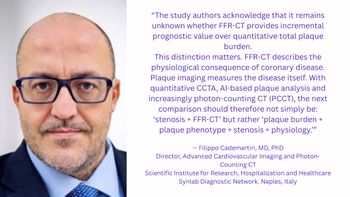
Dr. Cademartiri is the director of advanced cardiovascular imaging and photon-counting CT at the Scientific Institute for Research, Hospitalization, and Healthcare Synlab Diagnostic Network in Naples, Italy. He is also a consultant in advanced cardiovascular imaging at CDI/Centro Diagnostico Italiano in Milan, Italy.
Reference
- Rosendael AV, Nakanishi R, Bax JJ, et al. Whole heart atherosclerosis volume and risk for major adverse cardiovascular events across the clinical likelihood for obstructive CAD; the CONFIRM2 study. Amer J Prevent Cardio. 2026 June 24, 101712.
https://doi.org/10.1016/j.ajpc.2026.101712 .
(Editor’s note: This blog is adapted with permission from Dr. Cademartiri’s original LinkedIn post at:
Related to this article