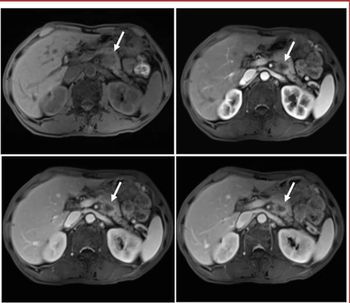
The study authors noted the superior accuracy with mpMRI was particularly evident with T1 (83 percent vs. 65 percent for DECT) and T4 tumor staging (78 percent vs. 68 percent). Multiparametric MRI also demonstrated 17 percent higher accuracy for N1 staging (41 percent vs. 24 percent) and a 19 percent higher accuracy for N3 staging (64 percent vs. 45 percent).
“The higher accuracy of mpMRI for identifying the N stage in our study might be explained by the fact that morphologic features, including nodal size, margin, and signal intensity on T2-weighted, zoomed DWI, and XD-VIBE DCE images, were incorporated into the interpretation of local-regional lymph node involvement,” noted Li and colleagues.
Three Key Takeaways
1. Higher accuracy of mpMRI for T and N staging. Multiparametric MRI (mpMRI) demonstrated higher accuracy compared to dual-energy computed tomography (DECT) for both T staging (61-77 percent vs. 50-64 percent) and N staging (54-68 percent vs. 51-58 percent) of gastric cancer, irrespective of the radiologist's experience level.
2. Superior performance in specific tumor stages. The study highlighted that mpMRI showed particularly higher accuracy in T1 (83 percent vs. 65 percent) and T4 tumor staging (78 percent vs. 68 percent), as well as N1 (41 percent vs. 24 percent) and N3 staging (64 percent vs. 45 percent), compared to DECT.
3. Clinical relevance: Accurate T and N staging with mpMRI can significantly impact treatment decisions, potentially allowing patients with T1 N0 tumors to avoid neoadjuvant therapy and its associated toxicity, and preventing unnecessary surgery in patients with unresectable T4 tumors.
In an accompanying editorial, Ramiro J. Mendez, M.D., and Susana Martin-Garre, M.D., Ph.D., said there is no currently no consensus with respect to the utility of MRI being superior for gastric cancer staging, and noted “highly variable” sensitivity and specificity rates reported for multiple imaging modalities, including MRI, for N staging.
However, Drs. Mendez and Martin-Garre said the findings of the current study indicating higher MRI accuracy in staging T1, T4a, N1 and N3 gastric cancer tumors are promising.
“These findings may have particular clinical relevance as patients with T1 N0 tumors may be treated with surgery without neoadjuvant therapy, avoiding the risk of toxicity. Precise T and N staging of locally advanced gastric tumors would also prevent unnecessary surgery in patients with unresectable T4 tumors,” pointed out Dr. Mendez, the chief of abdominal radiology at Hospital Clinico San Carlos in Madrid, Spain, and Dr. Martin-Garre, an associate professor of radiology at Universidad Complutense de Madrid in Madrid, Spain.
(Editor’s note: For related content, see “Computed Tomography Insights on GI Bleeding: Nine Takeaways from New Consensus Recommendations,” “Radiotherapy for Prostate Cancer: Study Says MRI Guidance Significantly Reduces GU and GI Toxicities” and “Could Photon Counting CT Supplant MRI for Imaging Assessment of Hepatic Steatosis?”)
In regard to study limitations, the authors conceded the possibilities of patient selection bias, due to limiting the cohort to patients who had surgery with curative intent, and recall bias, which may have resulted from a two-week interval between readings. Noting limited experience with endoscopic ultrasound at their institution, the researchers said they accordingly did not compare mpMRI to endoscopic ultrasound in the study.