• context-dependent reasoning;
• longitudinal decision-making; and
• integrating fragmented patient realities.1
That’s not a sidenote. That’s the whole game.
Medicine is not a board exam. Real medicine is incomplete data, conflicting signals, evolving disease over time, decisions under uncertainty and responsibility for outcomes. In other words, this is not a retrieval problem.
So what are we doing? We are benchmarking AI where it is strongest (structured knowledge, standardized logic and guideline concordance) and then projecting those results onto messy reality, real patients and longitudinal care. That leap is… optimistic.
But let’s challenge the counter argument too. Yes, historically, specialization was driven by “cognitive limits.” Yes, AI removes part of that constraint. But was knowledge really the main bottleneck or was it integrating context, managing uncertainty and making accountable decisions over time? These issues are not solved by AI.
Here’s the paradox nobody is discussing: the better AI gets at detecting and standardizing, the more edge cases, ambiguity, and borderline scenarios we will uncover.
This doesn’t eliminate specialists. It increases the need for real expertise, especially in fields like imaging, in which seeing more is not equivalent to understanding more, and detecting more is not equivalent to deciding better.
We are framing the future as: generalist plus AI vs. specialist. However, the real divide is: standardizable medicine vs. non-standardizable medicine. AI will dominate the first. Humans will still carry the second.
Maybe the real question is not: “Will AI replace specialists?” Maybe the actual question is: “Are we overestimating AI because we are testing it on problems that are structurally aligned with its strengths?”
Passing exams is easy. Owning decisions over time in real patients? That’s still medicine.
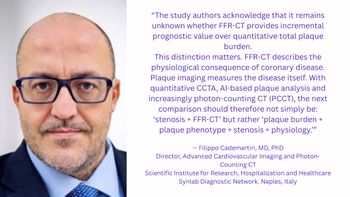
Dr. Cademartiri is the director of advanced cardiovascular imaging and photon-counting CT at the Scientific Institute for Research, Hospitalization, and Healthcare Synlab Diagnostic Network in Naples, Italy. He is also a consultant in advanced cardiovascular imaging at CDI/Centro Diagnostico Italiano in Milan, Italy.
Reference
- Kocher B, Nolan-Mangini S, Wachter RM. How AI will redefine care delivery: the rise of the generalist-specialist. Health Aff Sch. 2026 Mar 26;4(4):qxag075. doi: 10.1093/haschl/qxag075. eCollection 2026 Apr.
(Editor’s note: This blog was adapted with permission from Dr. Cademartiri’s original LinkedIn post at: https://www.linkedin.com/feed/update/urn:li:activity:7452074956043038720/ .)