
Blog|Articles|November 5, 2026
A Closer Look at the P4 Trial and CCTA-Guided PCI
Author(s)Filippo Cademartiri, MD, PhD
While the P4 trial represents a landmark study on the use of CCTA guidance for percutaneous coronary intervention (PCI), there are pertinent caveats that warrant closer inspection.
Advertisement
The recently published P4 trial is a landmark study, a major step forward for coronary computed tomography angiography (CCTA) and a perfect opportunity for some spectacular overinterpretation.1
Let's separate the science from the marketing.
Here is the good news.
• The P4 trial demonstrated that CCTA-guided PCI is noninferior to IVUS-guided PCI in selected patients.Researchers noted a 4.1 percent vs. a 4.6 percent target-vessel failure at 12 months.
• Shorter procedures. Less contrast during PCI. Comprehensive planning before entering the catheterization laboratory.
• This is a major achievement for coronary CT.
What Are the Key Caveats with the P4 Trial?
Now let’s discuss the uncomfortable parts of the study.
1. Noninferiority is not equivalence.The 4.5 percent noninferiority margin was almost as large as the observed event rate in the control group.
2. FFRct was not independently validated.All patients required stenosis >70% and FFRct ≤ 0.80. But nobody tested whether adding FFRct to anatomical CT planning actually improved outcomes.
3. Abnormal FFRct does not mean PCI is necessary. Even in this highly selected population, 8.1 percent received medical therapy alone. In the broader ADVANCE registry, approximately 55 percent of patients with stenosis ≥ 50% and FFRct ≤ 0.80 were not revascularized at one year.2 These are certainly different populations, but this is nonetheless a rather inconvenient reminder that physiological significance and clinical benefit from PCI are not synonyms.
4. What about photon counting CT (PCCT)?Only 4.1 percent of examinations used PCCT. Imagine what improved spatial resolution, calcium characterization and quantitative coronary assessment might contribute.
But let's generate evidence before generating headlines.
What is the Real Take-Home Message with the P4 Trial?
• The P4 trial validates a comprehensive CT-guided PCI strategy.
• It does not prove that every component of that strategy is indispensable.
• It does not prove that FFRct independently improves outcomes.
• It certainly does not mean every physiologically significant stenosis should be stented.
The future is not about CT defeating IVUS. It is about moving coronary decision-making upstream, integrating anatomy and physiology, and finally distinguishing between:
• having a stenosis;
• having ischemia;
• having atherosclerotic disease; and
• actually benefiting from PCI.
These are four different concepts that are still confused far too often.
The P4 trial is a landmark study but let's not turn it into a marketing brochure.
Dr. Cademartiri is the director of advanced cardiovascular imaging and photon-counting CT at the Scientific Institute for Research, Hospitalization, and Healthcare Synlab Diagnostic Network in Naples, Italy. He is also a consultant in advanced cardiovascular imaging at CDI/Centro Diagnostico Italiano in Milan, Italy.
References
- Collet C, Mizukami T, Bouisset F, et al. Coronary CT angiography versus intravascular ultrasound guidance for PCI. N Engl J Med. 2026 Nov 1. doi: 10.1056/NEJMoa2610771. Online ahead of print.
- Patel MR, Norgaard BL, Fairbairn TA, et al. 1-year impact on medical practice and clinical outcomes of FFRCT: the ADVANCE registry. JACC Cardiovasc Imaging. 2020;13(1 Pt 1):97-105. Doi: 10.1016/j.jcmg.2019.03.003.
(Editor’s note: This blog is adapted with permission from Dr. Cademartiri’s original LinkedIn post available at
Advertisement
Related to this article
While a new article raises provocative questions about the capability of photon-counting CT (PCCT) to perhaps replace diagnostic ICA, the real revolution with this modality is going beyond stenosis measurement to a renewed focus on the disease of atherosclerosis.
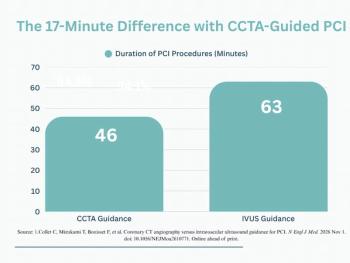
New research suggests CCTA may provide salient preoperative insights into planning for percutaneous coronary intervention (PCI) while facilitating similar outcomes as intravascular ultrasound guidance for target-vessel failure.
Catch up on the top radiology content of the past week.
In the second of a two-part podcast episode, Kalpana Kanal, PhD, and Mahadevappa Mahesh, PhD, discussed the possible impact of new research showing significant declines in CT radiation dosing over the past decade, future research directions and the potential for indication-based diagnostic reference levels (DRLs) in the future.
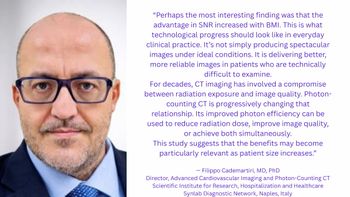
Emerging research suggests that the benefits of photon-counting CT may be more pronounced in patients with obesity.
In the first of a two-part podcast episode, Kalpana Kanal, PhD, and Mahadevappa Mahesh, PhD, reviewed key findings from a study examining CT radiation dosing over the past decade and shared insights from their experience for ensuring optimal radiation dosing for CT scans.
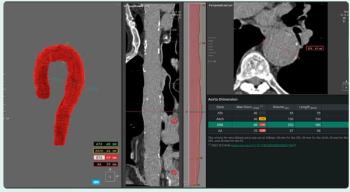
The newly cleared Aview Aorta Metrics software reportedly offers automated segmentation of aortic regions and classification of aortic zones based on chest CT images.

Catch up on the top AI-related news and research in radiology over the past month.
Advertisement
Advertisement
Trending on Diagnostic Imaging
1
Is Late Arterial Phase CT Necessary for Undifferentiated Acute Abdominal Pain?
2
FDA Clears Emerging AI-Enabled Platform for Intravascular Ultrasound
3
Interventional Radiology in Focus: Emerging Concepts with Ablation and Histotripsy in Interventional Oncology
4
Addressing Radiology’s Workforce Crisis: Can a Shift from Being Passive AI Users to Active AI Creators Have an Impact?
5