
A new formula proposed by the influential Medicare Payment Advisory Commission for calculating practice expense relative value units could cut technical payments for MRI, CT, and PET from the Medicare Physician Fee Schedule by as much as 44%.
A new formula proposed by the influential Medicare Payment Advisory Commission for calculating practice expense relative value units could cut technical payments for MRI, CT, and PET from the Medicare Physician Fee Schedule by as much as 44%.
Just as arterial calcium predicts coronary artery disease, the presence and extent of fat accumulations around the heart may indicate the presence of atherosclerosis.
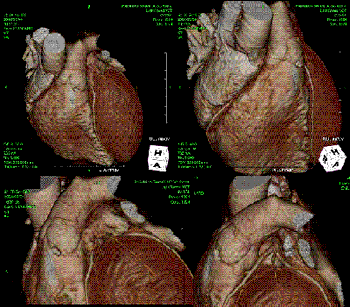
Multislice CT angiography can save lives by identifying occult congenital cardiac anomalies and disease that could lead to sudden cardiac death among competitive athletes.
The American College of Radiology and the American Roentgen Ray Society have announced a strategic alliance combining educational efforts formerly pursued independently by the two professional medical societies.
The American College of Radiology and the American Roentgen Ray Society have announced a strategic alliance combining educational efforts formerly pursued independently by the two professional medical societies.
An international clinical trial involving 50 healthcare facilities and nearly 2000 patients has found that physicians often do not apply available dose reduction strategies in procedures, resulting in a wide variation in radiation exposure.
FDA approval of a multicenter investigational new drug application has cleared away regulatory obstacles that stood in the way of definitive trials to establish the clinical efficacy of a PET imaging agent that measures cell proliferation in cancerous tumors.
Studies examining the clinical historiesof patients who developednephrogenic systemic fibrosis aftertreatment at distinguished teachinghospitals in New York City andVienna suggest that gadoliniumbasedcontrast dose and post-MRIhemodialysis are keys to controllingthe rare but deadly skin disorder
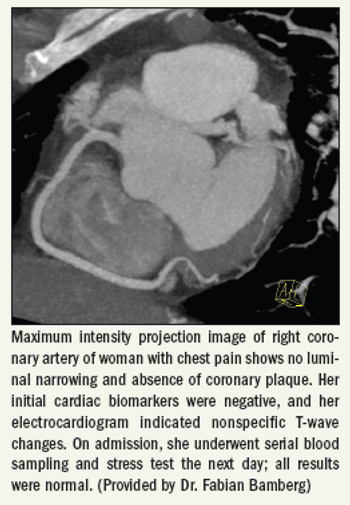
Cardiac imaging researchers are validatingbroader clinical roles for 64-slice and dual-source CT while introducingthe radiological world to evenmore powerful machines that promiseto lower radiation exposure andimprove resolution.
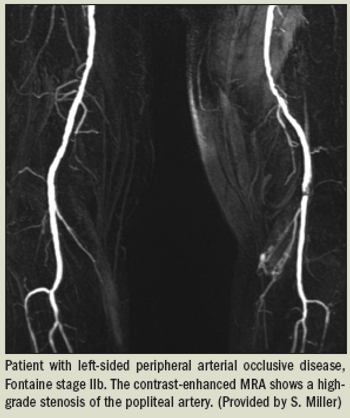
Prof. Dr. Stephan Miller and colleagues at the University of Tübingen in Germany have discovered that silent myocardial infarction raises the likelihood of a future major cardiac event for 14% of patients with symptomatic peripheral vascular disease evaluated with MRA.
Cardiac researchers assessing the benefits of revascularization therapies will operate a little less in the dark, thanks to salvage imaging, a new cardiac MR technique.
An experienced radiopharmaceutical manufacturer and a leading nuclear power plant builder have joined forces to bring back molybdenum-99 production to the U.S.
The FDA has issued an advisory warning physicians and patients about potential health risks from topical anesthetic lidocaine used to reduce the discomfort of breast mammography.
A National Research Council panel has concluded that commercial volumes of molybdenum-99 can be produced cost-effectively with low-enriched uranium. Mo-99 is the precursor of technetium-99m, a radioisotope used in most nuclear imaging procedures. The finding establishes a framework for weaning manufacturers of their reliance on nuclear bomb-grade uranium for Mo-99 production.
Illinois Attorney General Lisa Madigan has reached a $1.2 million settlement with a group of 14 Illinois radiology centers that allegedly paid illegal kickbacks to doctors in exchange for referrals.
A study from the Institute for Energy and Environment Research indicates that U.S. radiation exposure regulations and compliance assessment guidelines often underestimate the risk of radiation for women and children because they are based on standards of a “reference man,” a hypothetical 20- to 30-year-old white male.
The Centers for Medicare and Medicaid Services proposed Tuesday to grant routine Medicare payment for numerous cancer-related FDG-PET applications evaluated by the National Oncology PET Registry, a program managed by the American College of Radiology Imaging Network.
A big drop in exhibitor attendance led to an overall 5% decline in the number ofpeople who attended the 2008 RSNA meeting. Audited totals released by the RSNAafter the end of sessions on Dec. 5 indicate that 58,795 people attended the weeklongscientific assembly and meeting.
Dr. Stephan Miller and colleagues at the University of Tübingen in Germany have discovered that silent myocardial infarction raises the likelihood of a future major cardiac event for 14% of patients with symptomatic peripheral vascular disease evaluated with MRA.
The creators of CT screening colonographyhave not waited for the medicalestablishment and insurers to accept itas an alternative to optical colonoscopy.
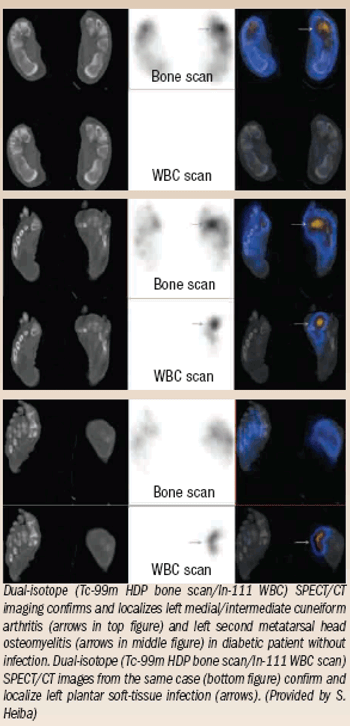
Nuclear medicine physicians at Mount Sinai Medical Center in New York City have reported encouraging results with dual-isotope SPECT/CT for accurately diagnosing and localizing infection in the feet of diabetic patients.
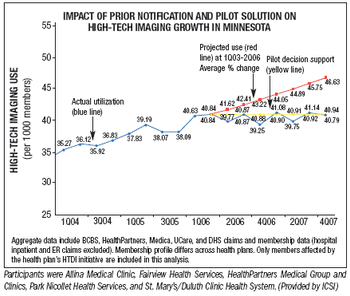
Physicians and insurers have joined forces in Minnesota to create an entry decision-support system that promises to improve the quality of physician referrals for high-tech medical imaging while linking the process to webbased electronic medical records.
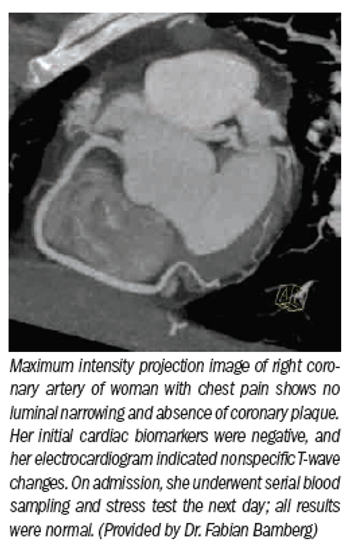
Cardiac imaging researchers are validatingbroader clinical roles for 64-slice and dual-source CT while introducingthe radiological world to evenmore powerful machines that promiseto lower radiation exposure andimprove resolution.
Medicare’s outpatient imaging program has issued a New Year’s greeting in the form of rules in the 2009 Physician Fee Schedule that raise professional reimbursement rates, expand the discount for contiguous body part imaging to more applications, and introduce anti-markup rules that are far less harsh than those originally proposed.
Simple strategies, based on past experience with contrast-enhanced MRI for patients with compromised renal function, have helped radiologists and allied physicians bring the incidence of nephrogenic systemic fibrosis, a rare but deadly skin disorder, under control.
Patients who receive iso-osmolar contrast media have a significantly higher risk of renal failure than those receiving low-osmolar contrast media.
Overall unaudited attendance at the 2008 Radiological Society of North America was down compared with last year, according to Thursday’s figures. But exhibitor registration took the hardest hit.
In the aftermath of Medicare’s less than encouraging evaluation of virtual CT colonography for colorectal cancer screening, Dr. Elizabeth McFarland used the RSNA’s Annual Oration in Diagnostic Radiology to identify past achievements and ongoing initiatives she believes will lead to the modality’s acceptance.
In the aftermath of Medicare’s less than encouraging evaluation of virtual CT colonography for colorectal cancer screening, Dr. Elizabeth McFarland used the RSNA’s Annual Oration in Diagnostic Radiology to identify past achievements and ongoing initiatives she believes will lead to the modality’s acceptance.
In response to demands for evidence that cardiac CT will positively affect patient outcomes, researchers presented results at the RSNA conference Wednesday attesting to its value for identifying which intermediate risk patients are most likely to suffer future catastrophic coronary events.