

News|Articles|July 4, 2026
Emerging PET/CT Radiopharmaceutical May Double Detection of Liver Foci in Patients with Neuroendocrine Tumors
Author(s)Jeff Hall
For patients with known or suspected neuroendocrine tumors, the radiopharmaceutical 64Cu-SARTATE offered over 50 percent higher average detection of liver foci than 68Ga-DOTATATE at four hours and 20 hours post-injection, according to research presented at the recent SNMMI conference.
Advertisement
New prospective comparative research suggests that the PET/CT radiopharmaceutical 64Cu-SARTATE may offer significant advantages over 68Ga-DOTATATE for detecting liver foci in patients with known or suspected neuroendocrine tumors (NETs).
For the phase 2 multicenter, non-randomized study, presented at the recent
The researchers found that PET/CT imaging with 64Cu-SARTATE four hours after injection detected an average of 348 liver foci in comparison to an average of 169.5 liver foci with 68Ga-DOTATATE. At 20 hours after injection, 64Cu-SARTATE detected over 186 more liver foci on average than 68Ga-DOTATATE (353.5 vs. 167), according to the study authors.
“The improved diagnostic performance coupled with the flexibility for imaging at optimal timepoints with 64Cu-SARTATE have important clinical implications to inform treatment decisions,” noted study co-author Dale Bailey, PhD, a nuclear medicine physicist affiliated with the Department of Nuclear Medicine at the Royal North Shore Hospital and the Faculty of Medicine and Health at the University of Sydney in Sydney, Australia, and colleagues.
(Editor’s note: For additional coverage of the recent SNMMI conference, click
The study authors determined that 64Cu-SARTATE offered a nearly 90 percent higher sensitivity rate than 68Ga-DOTATATE in cases involving discordant foci (94.7 percent vs. 5.4 percent).
The researchers also noted practical benefits with 64Cu-SARTATE.
“The use of copper-64 (64Cu) as an imaging isotope may be advantageous over gallium-68 (68Ga) due to its longer half-life (12.7 h vs. 68 min) and ability to be centrally manufactured,” added Bailey and colleagues.
Reference
- Lengyelova E, Kong G, Singhai N, et al. Diagnostic performance of 64Cu-SARTATE compared to 68Ga-DOTATATE in patients with known or suspected neuroendocrine tumors with focus on foci-to-liver uptake ratio findings. Presented at the Society of Nuclear Medicina and Molecular Imaging conference, May 30-June 2, 2026, Los Angeles. Available at:
https://jnm.snmjournals.org/content/67/supplement_1/261151 .
Advertisement
Related to this article

How will generative AI software be evaluated by the FDA in the future? What’s next for point-of-care ultrasound? What steps have been successful in facilitating adoption of AI applications across enterprise systems? Leaders in radiology and health care will be discussing these topics and more at the upcoming HLTH USA conference.
In the third of a three-part podcast episode, Wendie Berg, MD, PhD, FACR, FSBI, Manisha Bahl, MD, and Amy Patel, MD discuss recent developments with autonomous AI in breast imaging and share their perspective on the overall potential of AI to help mitigate the radiologist shortage.

In a recent interview, Amir Iravani, MD, FRACP, discussed the radiotherapeutic agent 177Lu-edotreotide and new dosimetry data from the COMPETE trial that was recently presented at the ASTRO conference.
In the second of a three-part podcast episode, Wendie Berg, MD, PhD, FACR, FSBI, Manisha Bahl, MD, and Amy Patel, MD discuss how to handle disagreements with adjunctive AI in breast imaging, whether to include AI assessments in PACS, and whether patients should pay for the use of adjunctive AI.
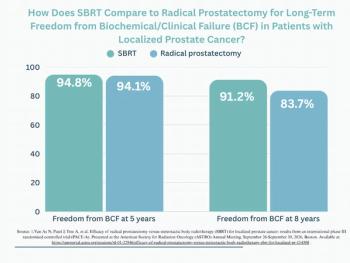
For patients with localized prostate cancer, stereotactic body radiotherapy (SBRT) offered comparable freedom from biochemical/clinical failure at eight years and nearly 40 percent lower urinary incontinence in comparison to radical prostatectomy, according to research presented at the ASTRO conference.
For patients with small cell lung cancer (SCLC), there was a 40 percent improvement in cognitive failure-free survival (CFFS) with brain MRI alone in comparison to the combination of brain MRI and prophylactic cranial irradiation (PCI), according to research presented at the ASTRO conference.
Catch up on the top radiology content of the past week.
Assessing breast MRI scans, pathology and clinical data, the AI-powered TumorSight Risk software reportedly provides five- and 10-year risk for breast cancer recurrence for women with HR+, HER2-negative stage I-IIIA breast cancer.
Advertisement
Advertisement
Trending on Diagnostic Imaging
1
FDA Clears First MRI-Derived AI Software for Assessing Breast Cancer Recurrence Risk
2
Diagnostic Imaging's Weekly Scan: October 11 — October 17
3
What a Large Prostate MRI Study Reveals About AI and Unassisted Radiologist Assessment
4
How Photon-Counting CT Helps Us Recognize that Coronary Stenosis is Just One Piece of the Puzzle
5