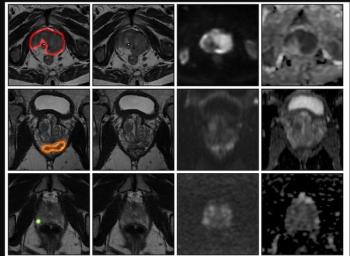
“ … Deep learning features may offer a more comprehensive description of PCa MRI and capture the biological characteristics of the tumor more effectively. The enhanced performance of deep learning could be attributed to its ability to extract richer and more comprehensive features through image enhancement techniques such as random cropping, horizontal and vertical flipping, and multiple image convolution transformations,” wrote lead study author Yue-yue Zhang, M.D., who is affiliated with the Department of Radiology at the Second Hospital of Soochow University in Suzhou, China, and colleagues.
Validation testing also revealed an 81 percent accuracy rate, 82.2 percent sensitivity and 78 percent specificity, according to the study authors.
Three Key Takeaways
1. Predictive model performance. The deep learning, radiomics, and clinical model (DLRC) demonstrated high predictive accuracy for perineural invasion (PNI) in prostate cancer, with an area under the ROC curve (ROC AUC) of 91.4 percent in the training set and 84.8 percent in the validation set.
2. Impact on preoperative planning. The non-invasive DLRC model could significantly enhance preoperative planning and follow-up strategies for patients with prostate cancer, potentially leading to better outcomes by enabling more precise surgical interventions and surveillance.
3. Improved feature extraction. Deep learning techniques, such as image enhancement, enhance information obtained from prostate MRI, including key biological characteristics of tumors, that may help bolster the performance of a predictive model for perineural invasion in patients with prostate cancer.
The researchers maintained the use of this non-invasive predictive model could have a significant impact in preoperative planning for patients slated to undergo radical prostatectomy procedures as well as follow-up surveillance strategies for those with PNI.
“Some studies have indicated that low-grade PCa with PNI is associated with a higher risk of tumor progression during follow-up than cases without PNI,” noted Zhang and colleagues. “As a result, there may be a need to consider some adjustments to the follow-up strategy for PCa patients in active surveillance, including shortening the follow-up intervals or considering immediate surgical intervention.”
(Editor’s note: For related content, see “Could MRI-Based AI Offer Better Risk Stratification for Prostate Cancer than PI-RADS?,” “MRI-Based AI Model Facilitates 50 Percent Reduction in False Positives for Prostate Cancer” and “Study: Adjunctive AI Imaging Software Enhances Contouring of Prostate Cancer.”)
Beyond the inherent limitations of a single-center retrospective design, the study authors acknowledged they did not assess the count of PNI, which contributes to biochemical recurrence risk, and utilized the maximum slice of lesions in developing the deep learning capabilities of the model. The researchers also conceded the lack of external validation for the model.