
Blog|Articles|November 23, 2026
Pardon the Interruption Radiologist
Author(s)Eric Postal, MD
While recurring interruptions can be a constant source of frustration for many radiologists, there may be opportunities to work with like-minded colleagues to facilitate necessary changes in procedures and protocols.
Advertisement
A tidbit of advice you have probably heard more than once: “Never interrupt your enemy when he is making a mistake.” It is frequently easier said than done. The concept is worth broadening. I would suggest never interrupting anybody who’s doing something you want...and have had many occasions of trying conveying that sentiment to others.
Beetlejuice (the ghost with the most) summed it up a little more abruptly but to-the-point: “How dare you interrupt a professional while he’s working!” If I had to pick my number one source of dissatisfaction with jobs over the years, this would be it.
Of course, some interruptions are unavoidable, especially in fields like health care. Emergencies respect neither calendar nor clock. They happen when they happen. Even without a crisis, some fields defy organization. Hospitals and busy imaging centers aren’t the sort of places where everything waits its turn in an orderly, first-in-first-out process.
That being said, there are plenty of things that can. Every time you needlessly interrupt something from what would have been its smooth operation, you diminish efficiency and increase chances of error.
To me, it seems basic courtesy and common sense. Be on the lookout for when something you are about to do might interrupt someone. If you can do something else instead or do your thing later, when it might not be as much of an interruption, you probably should.
Maybe you are stressed or otherwise distracted and proceed with an interruption that did not really need to occur. The next best thing is to recognize how you could have done things better (or listen when the person you interrupted tells you) and let it guide your future performance.
As sensible as that might sound in the abstract, it doesn’t pan out all that reliably in the real world. Much of the time, that is because the interrupter (or interrupted) doesn’t have motivation or power to do things differently.
My first couple of radiology jobs after fellowship were constant examples of this. There was more than enough work to keep all the rads busy. Someone who wanted the practices to run well might hope that the rads would spend as much time as possible reading cases and doing procedures.
It was rare, however, that they would be left alone to do this. A parade of ancillary staff would come to the reading rooms all day long with questions, paperwork, and chitchat. Calls would be forwarded to the rads’ phones from all over the place without anything resembling a screening process. Any time a patient needed an IV, a rad would be summoned (because hiring a non-doc to do that would cost money).
Most of the rads didn’t really care. They were salaried without any sort of productivity incentive: Go ahead and interrupt me all you like. I am leaving at 5 p.m. regardless. If this place’s inefficiency means there is a stack of unread cases when I go, that is your problem.
Trusting dummy that I am, I thought I would have a chance at partnership or some other meaningful promotion if I did better than that. So I flogged myself to get more work done, tried to establish less interrupting processes, and appealed to the bosses when I thought more could happen in that regard. Long-term readers of this blog know how that failed to work out.
My subsequent jobs were more productivity-oriented, and thus better structured to avoid interruptions. My first per-click gig was in the biggest telerad entity that existed at the time. While they were notorious for paying bottom-rung rates per RVU, their efficiencies were such that a hard-working rad could do better for him- or herself there than almost anywhere else.
That didn’t mean they were flawless. Indeed, if you asked just about any rad working for them, the rad would probably be able to immediately name half a dozen types of recurrent interruption, often with proposed remedies for each one.
As efficient as the place was overall, it didn’t have much of a mechanism for these rads to get their concerns addressed. Sure, there were people they could contact and means of submitting feedback but that didn’t reliably get more than lip service in return. That is a weakness of such huge organizations. To change anything, you have to wade through committees and run a gauntlet of stakeholders who have got a bunch of reasons (including inertia) to oppose you.
It is one of the reasons I subsequently aimed for smaller rad groups. When there is only a handful of other rads and they are working alongside you in the trenches, they encounter the same issues you do. If you pipe up that interruption X annoys you a couple times every day, they are liable to have the same experience. All it might take is your suggestion that things could be done another way, they like the sound of it, and presto! Protocols get tweaked.
Software upgrades automatically happening in the middle of your shift? Now they are scheduled for off-hours, or set up so you can initiate the installation with a click when it fits into your day. Instant messages regarding urgent cases or protocol questions constantly buzzing around your desktop like gnats? Now the cases get posted on a separate “someone please grab this” Teams channel for all to see.
The best part about solutions like those is that, sometimes, you want an interruption. If I have just completed a slog of a cancer follow-up scan and reaching for the next catastrophogram is daunting, maybe I could use a breather. Hey, here is a quick task in the form of a mental palate cleanser. It will be constructive and better for me than doomscrolling on X or going looking for a snack my waistline could do without.
Advertisement
Related to this article
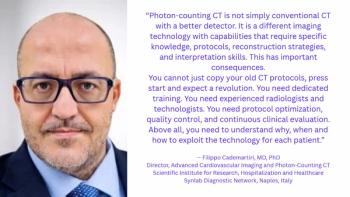
Having the technology of PCCT in one thing. Having the experience to apply the technology and interpret PCCT images is another.

In a recent interview at the HLTH USA conference, John Whyte, MD, MPH, shared his thoughts on the promise and limits of AI in health care.
More effort and detail on a clinical history may spark reciprocal diligence on imaging interpretation and possibly facilitate earlier detection.
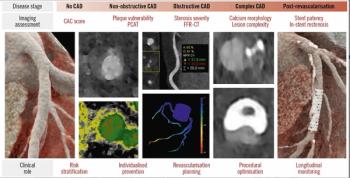
Through enhanced insights into atherosclerotic disease, complex coronary lesions and coronary stents, photon-counting CT provides an anatomical roadmap that may improve outcomes for interventional procedures.
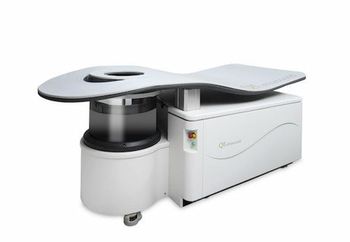
Effective January 1, 2027, use of the QTscan in outpatient diagnostic exams will be reimbursable with the CPT code 1079T.
Keeping defensiveness and ego at bay is just one of the attributes of those who consistently embrace learning from others over the course of one’s life.
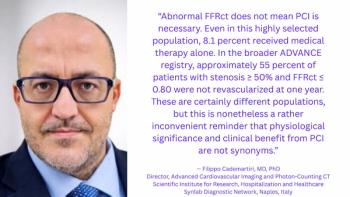
While the P4 trial represents a landmark study on the use of CCTA guidance for percutaneous coronary intervention (PCI), there are pertinent caveats that warrant closer inspection.
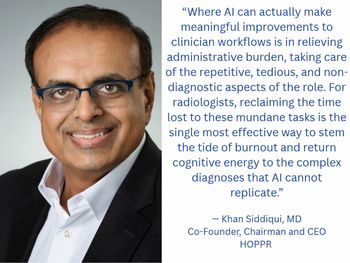
Amid the burgeoning imaging volumes and ongoing radiologist shortage, this author suggests that more active involvement by radiologists in the creation and development of AI models could go a long way.
Advertisement
Advertisement
Trending on Diagnostic Imaging
1
Radiology Reflections on AI, Theranostics and Empowered Patients: An Interview with Phillip Koo, MD
2
FDA Clears CCTA-Based AI Software for Facilitating Management of Coronary Artery Disease
3
FDA Clears Emerging AI Triage Software for Nine Findings on Abdominopelvic CT
4
MRI and PET Imaging Study Suggests Links Between Metabolic Health, Midlife Body Composition and Alzheimer’s Disease
5