In the second of a two-part interview, Kalpana Kanal, PhD, and Mahadevappa Mahesh, MS, PhD, FAPPM, FACR, discussed future directions for research on CT radiation dosing, including the potential of indication-specific diagnostic reference levels (DRLs).
In the first of a two-part podcast episode, Lauren Nicola, MD, Christoph Wald, MD, PhD, MBA, and Peter Shen discuss current challenges with reimbursement for AI in radiology.
The use of adjunctive AI for pulmonary nodule assessment on chest CT exams led to over a three-minute reduction in median reporting time, according to newly reported research.
In the first of a two-part interview, Kalpana Kanal, PhD, and Mahadevappa Mahesh, MS, PhD, FAPPM, FACR, discussed recently published research showing significant declines in computed tomography (CT) radiation dosing over the past decade.
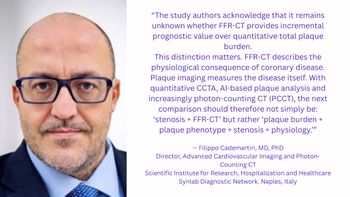
A new study shows that even small plaque volume may be associated with significantly higher risk for cardiovascular events, making the enhanced spatial resolution available with advanced imaging even more critical in risk stratification.
In comparison to contrast-enhanced CT, FAPI PET was associated with over 27 percent higher sensitivity for peritoneal carcinomatosis in the small bowel and 53 percent higher sensitivity in the upper abdomen, according to a new study involving 200 women with primary ovarian carcinoma.