In the second of a two-part interview, Kalpana Kanal, PhD, and Mahadevappa Mahesh, MS, PhD, FAPPM, FACR, discussed future directions for research on CT radiation dosing, including the potential of indication-specific diagnostic reference levels (DRLs).
In the first of a two-part interview, Kalpana Kanal, PhD, and Mahadevappa Mahesh, MS, PhD, FAPPM, FACR, discussed recently published research showing significant declines in computed tomography (CT) radiation dosing over the past decade.
A new study shows that even small plaque volume may be associated with significantly higher risk for cardiovascular events, making the enhanced spatial resolution available with advanced imaging even more critical in risk stratification.
Elevated coronary inflammation, measured with the CCTA-derived and AI-enabled perivascular fat attenuation index (FAI) score, was associated with over a 12-fold higher risk for cardiovascular mortality in patients with no diabetes, hypertension, smoking history or obesity, according to new research presented at the European Society of Cardiology (ESC) Congress.
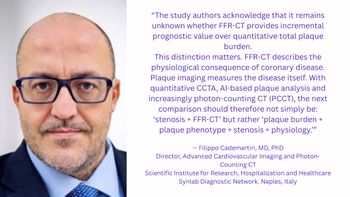
New research presented at the European Society of Cardiology (ESC) conference demonstrates that fractional flow reserve (FFR) based off CCTA exams significantly decreases unnecessary invasive coronary angiography (ICA) procedures for patients with stable chest pain and obstructive stenosis.
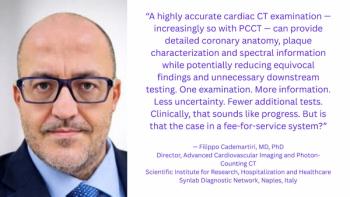
In addition to providing stronger image quality, well-designed photon-counting CT systems may facilitate increased standardization, efficiency and simplification that may lead to reduced cognitive burden for radiologists.